


|
Musicologists often revere Olivier Messiaen's 1941 Quatuor pour la fin du Temps (Quartet for the End of Time) as one of the most, if not the most, important works of the twentieth century.
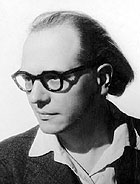 Olivier Messiaen |
 The tale of the Quatuor's origin is indeed compelling. Born in 1908 to a teacher and a poet, Messiaen was already attracting notice as a brilliant student, organist and visionary composer when he was drafted for wartime military service but assigned as a medical orderly due to his poor eyesight. Captured and held in an open field for three weeks, he met Henri Akoka, a clarinetist who remarkably had managed to keep his cherished instrument and for whom Messiaen wrote a solo piece.
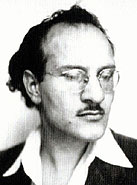 Henri Akoka |
In light of the unspeakable horrors of the Holocaust concentration camps seared into human memory, it seems apt to clarify the conditions under which Messiaen was held. Although food, heat and clothing were sparse, Stalag VIIIA was not a death camp (nor, at the other extreme, the cruelly-deceptive artist showcase of Theresienstadt, much less the insultingly light-hearted lark of Hogan's Heroes), but rather akin to the conditions depicted in Renoir's Grand Illusion – indeed Le Boulaire claimed to have been profoundly bored, Akoka spent much of his time trying to escape, and the camp had a library, newspaper and concerts. Despite overall deprivation, Messiaen fared rather well.
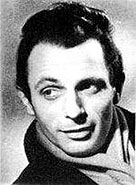 Jean Le Boulaire/Lanier |
The Quatuor arose over the course of several months, and was rehearsed four hours a day. Le Boulaire recalled that although the score was difficult and his demands severe, Messiaen provided constant guidance and reassurance. The camp commandant loved music and obtained instruments, including a violin and piano. Pasquier told movingly of how fellow-prisoners collected funds to buy a cello, with which he gratefully entertained them.
 A special notice with an art-deco design (and bearing the camp's stamp of approval) announced the premiere which took place at 6 PM on January 15, 1941 as the week's regularly-scheduled Saturday concert. Sadly, even modern program annotators still perpetuate myths asserted by the composer himself: a crowd of 5,000 jammed into the theater, the cello had only three strings, the clarinet was missing a key and the piano keys all stuck.
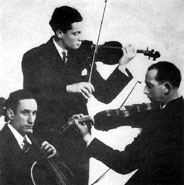 Trio Pasquier |
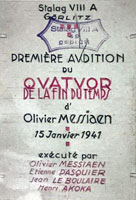 inmates and even recuperating ill prisoners attended, and that the performance was heard in silence (whether out of respect for Messiaen's reputation, gratitude for a brief cultural respite, or sheer perplexity). While the music was strange even to trained ears, and many were unaccustomed to chamber music, clearly all seized upon the occasion as a profoundly spiritual vehicle to escape actuality, if only for a few moments, and it resonated deeply within each man's soul. Despite Messiaen's penchant for exaggeration (which Rischin attributes to his desire to stress how far he transcended the challenging circumstances), it's hard to doubt his oft-cited ultimate recollection: "Never have I been heard with as much attention and understanding."
In spite of the tight bond that must have formed during the months of focused preparation, the four musicians never performed the work again. The next month Messiaen and Pasquier were liberated as part of a political gesture prioritizing the repatriation of unarmed artists (and with the help of forged papers provided by Brüll to erase their status as soldiers, who were ineligible for release). With his brothers, Pasquier went on to renew their illustrious Trio, which over the next three decades extensively concertized and compiled a magnificent discography of elegant performances from Mozart to moderns. In April Akoka succeeded in escaping – with his precious clarinet! – passing through enemy lines as an Arab and ultimately enjoyed a long career playing in French orchestras. After an unsuccessful attempt, in late 1941 Le Boulaire also escaped thanks to more of Brüll's forgeries but felt that he and his artistry had suffered too severely during his confinement and so he proceeded to bury his career, memories and even his name by becoming an actor under a new identity of Jean Lanier. Of the four, Messiaen fared the best of all. Repatriated, he formalized the musical innovations of the Quatuor into a hugely influential treatise (Technique de mon langage musical), returned as organist at the Trinity Church in Paris (a post he held for a remarkable 60 years, interrupted only by the War, and which Anthony Pople notes was at odds with his radical musical sensibilities), began teaching at the Paris Conservatoire (in part to replace ousted Jews), went on to become one of the leading musical pedagogues and theorists of his time, and produced an extraordinary body of compositions.
Messiaen's Catholic religion was a moving force behind the Quatuor, and indeed of his entire output. 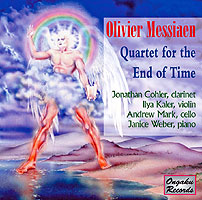 He prefaced not only the work itself, but each movement, with a text of spiritual illumination. As published, the score is preceded by an abridgement of the potent imagery of Chapter 10, Verses 1-7 of the Book of Revelation (in French, of course, but given here in the King James translation):
And I saw another mighty angel come down from heaven, clothed with a cloud: and a rainbow was upon his head, and his face was as it were the sun, and his feet were as pillars of fire: and he set his right foot upon the sea, and his left foot on the earth, And the angel which I saw stand upon the sea and upon the earth lifted up his hand to heaven, And sware by him that liveth for ever and ever that there should be time no longer: But in the days of the voice of the seventh angel, the mystery of God should be finished.
 Each of the eight movements of the Quatuor invites an opportunity to consider a distinctive and often unique characteristic of Messiaen's work and his contributions to the course of Western music. So let's consider those aspects (highlighted below in red), rather than attempt a thorough analysis.
I: Liturgie de cristal (Crystal liturgy) – While (according to Messiaen's prefatory text) nominally intended to depict an awakening of birds before dawn that, in turn, invokes the harmonious silence of heaven, the first movement serves to introduce both of Messiaen's two foremost theories.
• Rhythm – Although the Quatuor's title can refer to deliverance from man-made constraints or to the rapture of eternity foreseen in Revelation, its deeper significance emerges when taken literally – Messaien sought to end our accepted notions of musical time and to replace them with his more wide-ranging, complex and variegated methods. 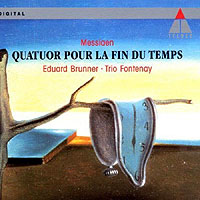 Many musicians and scholars have come to laud Messiaen as Western music's first great theoretician of rhythm (and indeed he reportedly described himself as "compositeur et rhythmeticien"). Messiaen despised all music that relies on predictable repetition and a uniform beat, even jazz – he considered syncopation to exist only because it is placed over and contradicts equal note values. In classical music he revered Mozart as having a kinetic quality with irregular accents derived from language (which, to him, also mandates their critical placement in performance). "My music depends on uneven beats, as in nature. In nature rippling water is uneven, waving tree branches are uneven, the movement of clouds is uneven." (Alex Ross suggests that Messiaen in part was rebelling against the regimentation and mechanized insanity of war, both in rejecting the militaristic overtones of incessant rhythm and in offering the purest sounds he could muster. Andre Hodier, though, considers Messiaen's rhythmic vitality as a more general defense to the anarchy left when the tonal system became exhausted and could not be fully replaced by the arithmetic 12-tone system.)
As a student, Messiaen began an intensive study of ancient Greek music, which followed the inflections of poetry to combine short and long durations into "feet" and hence into meters that often had values of prime numbers (5, 7, 11, etc.). Thus Messiaen's focus is upon varying free multiples of short duration rather than regular meter. "Essentially, rhythm is change and division. To study change and division is to study time. Time – measured, relative, physiological, psychological – is divided in a thousand ways. … In eternity these things do not exist." He also studied the Sangitaratnakara ("The Ocean of Music"), a comprehensive 13th century Indian treatise by Sarngadeva that explores 120 talas (regional rhythmic formulas).
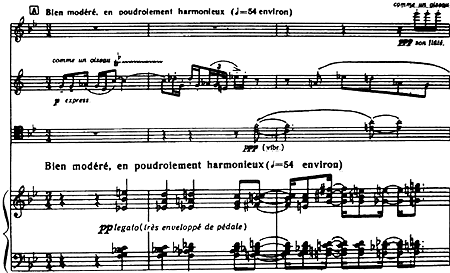 The cello and piano cycles begin, as violin and clarinet add bird calls |
Applying his approach to the first movement, he separated pitch and time by assigning to the piano a series of 29 complex chords (comprised of up to nine notes) that are cycled without alteration, but played using an ostinato (exact repetition) of 17 durations in a rhythmic sequence comprising three of the Hindu talas. At the same time, the cello keeps repeating its own cycle of 15 entirely separate notes (but without regard to constantly varying rhythms). The result is three types of seemingly independent pedals – harmonic (the piano chords), rhythmic (the piano sequence) and melodic (the cello phrase). At the leisurely tempo (54 quarter notes per minute, further marked "Bien modéré, en poudroiement harmonieux" – well restrained, in a harmonious haze) it would take hours for this massive cycle of prime numbers to arrive back at its starting point, but Messiaen cuts it off abruptly after a mere 2½ minutes, barely enough time for even the most trained ear to grasp the process from this brief fragment. Atypically for Messiaen, the scheme seems to emphasize mechanics over inspiration and is far more apparent on paper than to the ear. Paul Griffiths traces the unresolved chords to Debussy and the scheme to the vast cycles of Indonesian gamelan; Michael Linton likens the result to a religious icon that affords a mere glimpse into reality; and Robert Morgan calls the constant mutation of details a static timelessness and the refusal of pitch and rhythm to coincide a throwback to medieval music.
• Mode and Melody – Messiaen organized his structures horizontally through his concepts of rhythm, and considered his theories of melody as a vertical complement (thus, as Hodier notes, achieving complete control in both dimensions of sound). 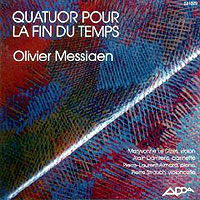 Rather than resort to diatonic scales, Messiaen created seven modes, each of which can be transposed (raised by a half-tone) a limited number of times before arriving back at the original set of notes (albeit in a different order). Within each transposition, the notes of a mode can be arranged into melodies and chords. Complexity arises from modulating from one to another transposition of a mode or even to another mode and its transpositions altogether; from adding foreign notes for intense expression; by superimposing two modes; by mixing modes with conventional tonality; and by constructing chords using high (and largely attenuated) overtones of fundamental notes. Peter Evans considers the system to prescribe limits within which the composer may move, and even dwell upon notes that form conventional successions and simultaneities, while Ross hears its peculiar harmony as suffused with surrealist, futurist energy. (Indeed, looking further ahead Messiaen foresaw extending his theories to quarter-tones.) Peter Burkholder, Donald Jay Grout and Claude V. Palisca assert that instead of developing themes Messiaen juxtaposes static ideas, and that since modes lack the differentiation of diatonic scales they do not create a strong urge for resolution and thus are well suited to contemplation and a negation of desire, spiritual qualities that infuse the Quatuor. According to Messiaen, the goal is "an iridescent music that will delight the senses with delicate, voluptuous pleasures." The "danger," though, parallels that of his rhythmic structures – to most listeners the system is far too complex to grasp aurally and can sound like random anarchy, even if its logic is pure to the composer and can be gleaned from intensive study of the score. Indeed, a skeptic might claim that nearly any sequence or combination of notes can be justified as falling within one or another transposition or modulation among the many modes (or, failing that, including expressive "foreign" notes), thus suggesting that the system and its ostensible rules are erratic, if not outright illusory.
The first movement uses the first and simplest of Messiaen's modes, based on the six-note whole-tone scale, of which there can only be a single transposition. That is, by transposing the entire whole-tone scale (C-D-E-F#-G#-A#) up one half-tone a set of new notes is obtained (C#-D#-F-G-A-B), but any further transposition, no matter how many degrees up or down, results in a set of notes identical to either the original or the single transposition. (The system relies on equal-tempering and enharmonics, such that A-sharp is identical to B-flat, etc.) Here, the cello keeps repeating a set of five of the six original notes (C-E-D-F#-A# [the last written as B-flat]) and combines three iterations of that five-note motif into a single 15-note theme. However, typically for Messiaen, this structure is partly disguised, and our attention diverted, both by a constantly-varying rhythm and by using the theme as the fundamental note of double-stopped chords.
• Further Complications – And if all this complexity were not enough, Messiaen adds several further layers of complication.
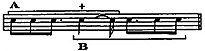 A non-retrogradable rhythm (B reverses A) with added values (dots and 16th note) (example from Messiaen's Treatise) |
All of this raises the predicament of much avant-garde music, which most audiences tend at best to intellectually tolerate rather than genuinely enjoy. Griffiths considers Messiaen more concerned with how music is put together than how it sounds. While we can (and should) salute composers' boldness and vision, music that requires theoretical analysis to make sense can seem akin to a joke that has to be explained. Viewed another way, the traditional Western musical system arose and endures for the very reason that it follows the laws of physics and reflects our biology. Thus common structures gratify our desire for repetition and resolution, consonant chords observe the natural overtone series, and the acceleration and deceleration of a regular beat follow the impact of emotions on our heart rate. Consequently, we hardly can be blamed for embracing the rudiments of the music most of us love – and for rejecting works that depart from the comfort of our expectations and experience.
If the first movement of the Quatuor harshly bombards us with strange and novel rhythmic and harmonic systems,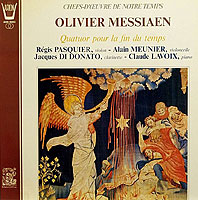 and thus is hard to grasp, the remainder makes a far more immediate and welcoming impression.
II: Vocalise pour l'Ange qui annonce le fin du Temps (Song without words for the Angel who announces the end of Time) – In the middle, moderate section of this movement (marked "Presque lent, impalpable, lointain" – "nearly slow, intangible, distant") the violin and cello double each other two octaves apart with a gently rolling melody over 16th note piano chords (the clarinet is silent). Messiaen described it as: "the ineffable harmonies of heaven" surrounded by "soft cascades of blue-orange chords." (He further describes the angel of the robust opening as "his hair a rainbow and his clothing mist.") Messiaen shared the fascination of Russian composers with synaesthesia, an association of color with keys and harmony (although, as Pople notes, no consensus ever emerged as to which colors to associate with a particular musical element). Unlike most of the other attributes of the Quatuor, this is strictly a personal connection, with no expectation of a phenomenon to be shared with listeners. Rischin suggests that Messiaen's sensitivity to color might have been prompted by a love of stained glass representations of his beloved religious symbols, but Messiaen later claimed a more earthly source: "While I was a prisoner, the lack of food gave me colored dreams; I saw the angel's rainbow and strange swirlings of color." In conversations with Claude Samuel, Messiaen saw precise colors and shapes in each transposition of each of his modes. Thus, he envisioned the first transposition of his Mode 2 as: "blue-violet rocks speckled with little gray cubes, cobalt blue, deep Prussian blue, highlighted by a bit of violet-purple, gold, red, ruby and stars of mauve, black and white" and the second transposition as: "gold and silver spirals against a background of brown and ruby-red vertical stripes." He further related brighter colors to higher notes. Here, all three instruments dwell almost entirely in the treble register, thus suggesting, regardless of specific colors and despite the mystical tempo indication, that Messiaen at least envisioned an overall vivid and intense impression.
III: Abîme des oiseaux (Abyss of the birds) – A clarinet solo, this sparest movement most likely was the first to have been written, for Akoka to play in the open field prior to transport to the Stalag. (That seems a reasonable assumption – for some time he was the only one of the four musicians having an instrument.) Pople, though, contends that the original piece likely formed a mere basis for a more developed version in the Quatuor. Comprising "precise yet interconnected gestures, slow, trancelike chanting lines intertwining with rapid runs and squawks and trills" (Ross), it would seem to symbolize desire for the freedom of flight from confinement or, as Messiaen put it in his preface to the score: "The abyss is Time with its sorrows and weariness. 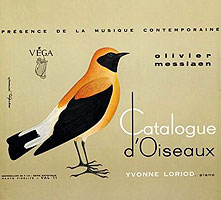 The birds are the opposite of Time; they are our desire for light, for stars, for rainbows and joyous songs!" An absence of bar lines in the score suggests interpretive rhythmic freedom and the yearning is accentuated by extreme dynamics, ranging from ppp to fff (and ultimately ffff) on single sustained notes. The long phrases and extremely deliberate tempo (44 eighth notes per minute) constantly challenge the performer's breath control.
This movement marks the first expression of Messiaen's life-long fascination with bird calls, which not only held a symbolic emotional allure of freedom during his captivity in the open field but technical significance as well. He wrote: "Birds are my first and greatest masters. … Their melodic lines often recall the inflections of Gregorian chant. Their rhythms are infinitely complex and infinitely varied, yet always perfectly precise and perfectly clear." Messiaen explained in his Technique that "since they use untempered intervals smaller than the semitone, and as it is ridiculous servilely to copy nature" he did not seek to replicate bird calls literally, but rather strove for "transcription, transformation and interpretation of the volleys and trills of our little servants of immaterial joy." He further conceded that accurate replication is beyond the ability of existing instruments and in any event he sought to transpose the calls to a human scale. Perhaps above all else, in birds Messiaen heard nature's own validation of his evolving revolution against the established norms of Western rhythm and tonality: "Through the mixture of their songs, birds make extremely refined jumbles of rhythmic pedals. Their melodic contours … surpass the human imagination in fantasy." Launched in the Quatuor and distilled in this movement, Messiaen's absorption in bird calls would govern his entire output in the 'fifties, culminating in the 1958 Catalogue d'oiseaux ("Catalog of birds"), a sweeping 13-movement, 2½ hour challenge of stamina and concentration for solo piano.
IV: Intermède (Interlude) – In a way, this is the most startling movement of the Quatuor if only for an unexpected reason – its relative orthodoxy.
 The playful theme of the surprisingly conventional Intermède scherzo |
V: Louange à l'Eternité de Jésus (Praise to the Eternity of Jesus) – 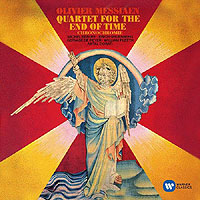 Both this and the complementary eighth movement ("Praise to the Immortality of Jesus") were adaptations from prior works. The finale fundamentally adds a sustained, insistent piano accompaniment to the melody of the second part of Messiaen's 1929 Diptyque for organ (now given to the violin) – a suitably sustained meditation which he subtitled an essay on blessed eternity. But the source of the fifth movement is far more surprising – the 1936 Fêtes des Belles Eaux (Festival of the Lovely Waters), written for six ondes Martinot (an electronic organ forebear that could sound single notes with a single timbre but with broad oscillation) to accompany an open-air spectacle of "dancing" water spouts on the Seine. While much of the flamboyant half-hour Fêtes would barely seem out of place at the garish Las Vegas Bellagio fountain display, here Messiaen recasts only its sweet, meditative fourth movement into a majestic melody for the cello at the very top of its range, accompanied by a steady pulse of slowly evolving triadic piano chords. Pople suggests that the source evoked the memory of the "pre-War Parisian scene, with its intermingling refractions of light," so very far from the spiritual wilderness of Stalag VIIIA. In that light, it may have served as a psychological bridge between the carefree fourth movement and the more serious business yet ahead. Griffiths notes that while the specified tempo is Infiniment lent, estatique (Infinitely slow, ecstatic [in the sense of a state of eternal bliss]) the music solves a difficult perceptual problem, presenting a convincing image of eternity not by holding sounds for uncomfortable lengths but rather by giving an impression of changelessness through a protracted process of gradual change, which Griffiths credits as providing a foothold intelligible to minds existing in the present world.
VI: Danse de la fureur, pour les sept trompettes (Dance of fury, for the seven trumpets) – Rischin marvels that the four original artists bonded so well despite their disparate temperaments and religious outlooks – Pasquier was agnostic, warm and worldly, Le Boulaire atheistic and deeply depressed, Akoka a secular Jew and revolutionary who was constantly planning escape, and Messiaen a devout Catholic who accepted his fate as God's will. That cohesion must have been sorely tested by the formidable technical challenge of the sixth movement, requiring six-plus minutes of quick, jagged rhythms played in unison octaves, much of it fortissimo at breakneck speed. To complicate matters, there is no time signature, bar lines are erratic and added values disrupt any sense of regular beats. 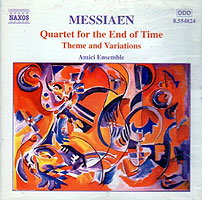 As Pople notes, even a marginally misplaced note would be cruelly exposed and could throw the entire ensemble off balance. The sheer level of virtuosity required to realize this movement serves as a formidable threshold for all artists who would dare to perform it.
VII: Fouillis d'arcs-en-ciel, pour l'Ange qui annonce la fin du Temps (Cluster of rainbows, for the Angel who announces the end of Time) – If the sixth movement poses the greatest challenge for performers, this climactic movement is apt to prove the most difficult for listeners. An example of Messiaen's notions of counterpoint and polymodality, structurally it sounds relatively simple. In Messiaen's description it alternates variations of a first theme with development of a second theme (derived from the second movement). Yet he pours into it an accumulation of his sophisticated but unconventional techniques – as Pople points out, in Messiaen's notions of development themes are not so much evolved as decorated and his counterpoint is not the traditional type in which the parts are adjusted to mesh harmonically, but rather overlays materials that are kept intact and conceptually separate. The result is sensory overload, which Messiaen approved as leading to his intended result: rather than absorb all the musical difficulties the listener will desire to be charmed and out of his confusion will be led to a "theological rainbow." As with much of Messiaen's theory, I cannot pretend to fully grasp this, other than in a somewhat perverse sense of fleeing impenetrable technicalities and opting, by default, to elect a realm of artless emotion; that is, to give up trying to analyze the music and just derive a degree of satisfaction from the overall sound, hopefully generating spiritual overtones.
VIII: Louange à l'Immortalité de Jésus (Praise to the Immortality of Jesus) – With the last movement we can confront the composer's own understanding of the entire work. Messiaen not only gave all but the fourth movement evocative titles but prefaced each with a brief explanatory narrative. Here, a languid violin floats over a constant rhythm of piano chords in a broad arc from E major to the dominant B and back again, gradually rising to its highest and softest harmonic.
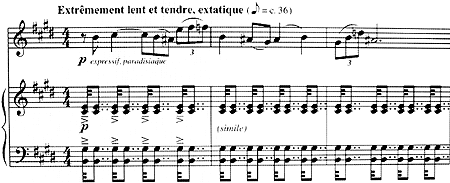 The final movement begins – earth-bound piano, soaring violin |
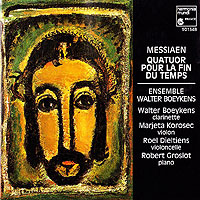 Yet in 1963 he seemingly disavowed his own prior description, writing that the unison instruments "do not pretend in any way to evoke the trumpets of the Apocalypse and the various catastrophes which accompany them. It is above all a study in rhythm."
Messiaen reportedly preceded the premiere with a lecture about Revelation, which he claimed as his direct inspiration, explaining his intent as not concerned with captivity but looking beyond the past and even the future to the beginning of eternity when time itself would be abolished, a metaphoric meaning of the title. (He also explained: "This quartet contains eight movements. Why? Seven is the perfect number, the creation of six days made holy by the divine Sabbath; the seventh in its repose prolongs life into eternity and becomes the eighth, of unfailing light, of immutable peace.") Griffiths attributes all this to Messiaen's theology of glory, less concerned with human sin than hope and expectation of salvation. The result, according to Linton, is breaking away from the "neo-pagan hysterics" of others' literal depictions to "a vision of heaven whose anger, violence, vengeance and despair are not so much repressed as irrelevant." As Ross puts it, "Messiaen's apocalypse has nothing to do with history or catastrophe but instead records the rebirth of an ordinary soul in the grip of extraordinary emotion" and "is the gentlest apocalypse imaginable." Indeed looking back in 1963, Messiaen wrote: "In the name of the Apocalypse my work has been criticized for its calm and its concern with detail. My detractors forget that the Apocalypse contains not only monsters and cataclysms but also moments of silent adoration and marvelous visions of peace." Indeed, the final moments truly invoke Messiaen's vision of "immutable peace" as the music trails off pppp and dissolves into the infinite reaches of silent space.
 Pople contends that, owing to the circumstances of its composition, the Quatuor has been largely immune from criticism.
  Rischin expands the meaning of the title to not merely an end but a triumph over time: "The story of its creation stands as a testament to the power of music and human will to transcend the most terrible of times" (or, in Ross's telling phrase, an escape from history and a leap into an invisible paradise). Linton considers it nothing less than a miracle for radiating joy and transcendence in the midst of squalor and misery. Ross proclaims it "the most ethereally beautiful music of the 20th century." Yet praise has been far from universal. Published reviews of the first public performance (in Paris, on June 24, 1941) were quite mixed. Thus Serge Moreux expressed delight with the joy of pure music, shimmering harmonies, intense sacredness and extraordinarily inventive rhythms while protesting that the remarks that Messiaen gave before each movement destroyed the continuity and annoyed the audience with its religious tone. (Arthur Honegger, himself a noted composer, excused the "literature" as a natural consequence of Messiaen's strong conviction and aspirations.) As early as 1945 Roland Bourdariat protested a turn from tradition to "so-called Hindu rhythms and pseudo-Oriental melodies" and asserted that Messiaen "preaches a pseudo-mystical jargon. The religiosity of his sermons cannot hide an unbelievably vulgar sensuality, as well as false and absurd doctrines." Hodier attacked a failure of form, giving rise to a sense of ultra-static monotony and inertia. The 1954 New Oxford Dictionary of Music, while broadly saluting Messiaen's innovations, proclaimed "the eight-movement Quatuor wearisome as a whole" and as late as September 1969, in a High Fidelity review of a new recording, David Hamilton heard "nothing but pretentious triviality in this music" of which he found "the saccharin content … pretty high."
Undoubtedly due to its nearly unique instrumentation and nature, its status as Messiaen's only chamber piece, and the expansion of his theories in later larger-scale works, the Quatuor has wielded less influence and attracted less critical notice than its historical position would seem to merit, at least compared to the totality of Messiaen's output. Morgan salutes Messiaen, in a clear break from Western musical norms, for treating the attributes of musical sound – e.g., pitch, rhythm, dynamics – as separable components, each with its own structural characteristics. That revolutionary impact perhaps is felt most directly through the work of two of his students, who arguably became the most important composers of the next generation. The Viennese 12-tone composers already had innovated the notion of serialization to control a work by sequencing a series of pitches, which Messiaen extended to rhythm. Pierre Boulez then applied serialization to dynamics, accents and textures, while Karlheinz Stockhausen extended the concept to spatial display and electronic sounds that became free from all connection with (and limitations of) scalar notes, conventional instruments and even the capacity of human musicians.
More generally, Griffiths summarizes Messiaen's stature as the first front-ranked composer to work apart from Western musical tradition by abandoning its sense of logic and continuity to create a condition for mental exaltation or reflection rather than elaborating a proposition – a meeting of the temporal and eternal, the human and divine, concerned less with space than time, creating a gravity-free elevated viewpoint for a spatial effect of viewing different aspects of a rotating object. The Quatuor contains a huge number of technical advances and arguably is the foremost key to much of the serialized music that would follow. Yet, while scholars can (and should) revel in its techniques, the Quatuor functions on a far more basic level. As Rischin states, it is "an intricate puzzle of seemingly disparate parts that miraculously makes musical sense."
 While the Quatuor was (and mostly remains) sui generis it spawned diverse progeny two generations later.
In 2014 Johanna Skibsrud published Quartet for the End of Time (Norton), a novel purportedly inspired by and structured around the Quatuor. 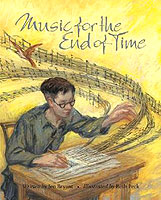
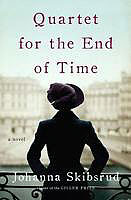 Admittedly, it contains seven chapters plus a central interlude of photographs, and a 30-page section tells of a poet who claims to have been at the Quatuor premiere and recounts (and elaborates with invented dialog and incidents) the tales of the composer and musicians (and even Brüll). More subtly, some passages are fragmented with a syntax of irregular rhythms that recall and reflect Messiaen's theories. (Thus the second sentence: "Who stood beside her, hand raised and trembling, before she finally brought it down: knocking, sharply, twice.") And yet, there are only three primary protagonists and the narrative rambles and lacks the sense of rigorous structure, concise editing and sheer elegance over which Messiaen labored so intensively in fashioning the Quatuor. (Interestingly, critical response was sharply divided and reflects present-day views of the Quatuor – many glowing professional reviews saluted its originality, but much reader reaction was blisteringly negative, largely chafing against length, density and overall difficulty.) Even so, the novel confronts (but mostly evades) the vexing challenge of translating the techniques of one artistic medium into the far different and seemingly incompatible realm of another. (Of more modest aspiration is Music for the End of Time, a heavily-sanitized and fanciful 32-page inspirational children's book by Jen Bryant with pastel illustrations by Beth Peck (Eerdman's Books for Children, 2006).)
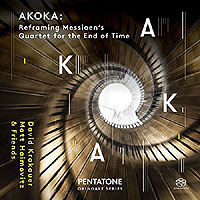
2014 also brought Akoka: Reframing Olivier Messiaen's Quartet for the End of Time (Oxingale Records), a recording of a live performance bracketed by two new movements inspired by the Quatuor. The prelude, entitled "Akoka," is by clarinetist David Krakauer. Partly improvised, it introduces various elements of the work (and alludes to Akoka's Jewish background) as sharp glissandi evolve into klezmer phrasing, bird twitters, nervous tremelos, insistent rhythmic percussion and complexly-layered polyphony. The new finale, "Meanwhile…" by sound-artist Josh "Socalled" Dolgin, begins with the bare piano rhythm of the end of the Quatuor, but soon is swamped by a seemingly random (and, to me, utterly meaningless) overlay of speech samples, snippets from the Quatuor, pop beats and more klezmer phrases, ending with alarm clocks (presumably intended to signal metaphorically that mankind needs to wake up – no argument with that!). 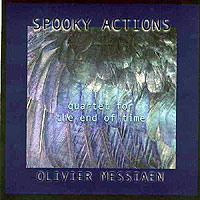
 While Akoka left the Quatuor itself intact, in 2005 Spooky Actions, a New York jazz and new music ensemble, transcribed the entire work for guitar, sax, piano, bass and drums (thus supplanting the violin textures and saturating the spare atmosphere with percussion fills) and inserted five "Improv" interludes that riff on the preceding movements (Muse-Eek CD). I do appreciate the impulse to engage new audiences by interpreting an unfamiliar work within a modern perspective. Yet I question whether the Quatuor really needs refreshing to remain relevant, or whether its message is sufficiently potent and ageless to stand unadulterated on its own.
Yet we now dwell in the age of video, in which the Quatuor is well represented by a wide variety of YouTube postings (mercifully, only a few prefaced with mood-jarring ads). Some are quite modest, dwelling on sustained images of album covers or dull montages of portraits or nature scenes that barely enhance the audio recordings they accompany. Live performances abound, ranging from basic continuous stage shots to those enriched with close-ups of performers’ expressive faces and hands (one intensified by especially dramatic lighting). Lectures span from straightforward didaction to one with interstitial poetry (and far more conventional than the name of the presenters – The Bach Dancing and Dynamite Society of Wisconsin – might suggest) and others featuring intriguing musical illustrations (one even presenting an Indian dancer to illustrate Messiaen’s exotic rhythms). Two especially valuable introductions are a wide-ranging, highly-informative and efficiently condensed presentation by Tom Redmond and the Manchester Collective and an intriguing documentary by Paul Moon that melds Dürer woodcuts, historical footage and modern meditations with refreshingly personal observations by the violinist in a quartet comprised of current members of the very military that helped liberate detention camps, thus blending past and present to evoke the Quatuor’s roots.
 Rischin asserts that the Quatuor was largely ignored for some time because both musicians and the public favored works that confronted, rather than transcended, the painful events, despair and memories of the war. Yet, while Toscanini and Stokowski fought for the 1942 American premiere of Shostakovich's graphic and bombastic Symphony # 7 ("Leningrad"), most wartime musical events (the weekly NBC Symphony broadcasts in America, Myra Hess's National Gallery concerts in London, even Berlin Philharmonic radio transmissions) served up comfort and placated anxiety via established classics. It seems more likely that the Quatuor simply had to endure the same resistance faced by all challenging modern work throughout history, requiring time before acceptance.
 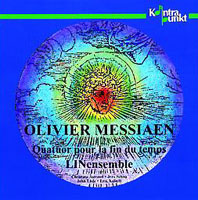 While concert performances still may be rare, the Quatuor has become by far the most popular of any Messiaen work on records – a half-century after its creation, the Schwann catalog listed 17 then-available CDs plus three more of the Abîme des oiseaux movement; in second place was the 1935 Nativité du Seigneur for organ with a mere seven CDs. Rischin listed no fewer than 32 separate complete recordings as of 2006 and YouTube currently boasts two dozen.
Rather than attempt a comprehensive survey of Quatuor recordings, I'd rather focus on the five that boast the authority of the composer's participation. Yet, curiously, they are quite different and even the only one on which he actually plays takes substantial liberties with the score. But perhaps that's not surprising. Messiaen ended his preface to the score with advice to performers which seems somewhat paradoxical. On the one hand, he wrote (in Rischin's translation) that: "it will suffice to play the music, the notes and the exact values, and to faithfully follow the dynamics indicated." That directive seems consistent with Pasquier's and Le Boulaire's recollections that Messiaen insisted that rhythms were to be scrupulously observed. Yet in the same preface Messiaen urged interpreters not to become preoccupied with his commentary or theories and cautioned them not to be overly concerned with counting note values:
[T]his process may encumber the public performance; you should, therefore, mentally retain the feeling of the rhythmic values, no more. Do not be afraid to exaggerate the dynamics, the accelerandos, the ritardandos, everything that renders an interpretation lively and sensitive. The middle of the "Abyss of the Birds," in particular, should be full of imagination.Rischin asserts that Akoka's specific instrument (a Couesnon clarinet and mouthpiece with a Périer facing) and its timbre (a brighter, thinner, more metallic sound than modern-day clarinets produce) influenced Messiaen's aural conception, and that he would ask others to play louder in an effort to emulate that sonic image. Pasquier recalled that Messiaen wanted fortissimos to be terrifyingly loud and slow tempos to verge on the impossible. Le Boulaire added that Messiaen sought color and often spoke of striving for spiritual ascendance to the beyond. Both agreed that Messiaen paid no attention to idiomatic writing for their instruments and that his demands upon their skill were extreme and insistent. All this would suggest his endorsement of interpretive leeway, but within a context of understanding and commitment.
- Olivier Messaien (piano), André Vacellier (clarinet), Jean Pasquier (violin), Etienne Pasquier (cello) (Club Français du Disc, 1956)
While we have nothing but emotionally-charged witnesses' memories of the Stalag premiere, our closest sound document is this first recording, in which the composer and the original cellist were joined by Etienne's brother (the violinist in the Trio Pasquier) and a clarinetist with the Paris Opera whom Messiaen later commended as a great artist who played his part wonderfully and with perfect technique; indeed here Vacellier does manage to achieve the metallic timbre that Messiaen so admired in Akoka. 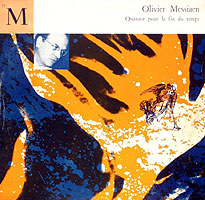
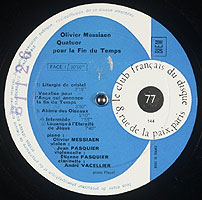 Although 15 years had elapsed, these were the same four musicians who had given the first public performance in Paris mere months after the premiere. (Le Boulaire was still interned at that time and Akoka remained underground through the rest of the war. Later reunions of all four original artists presumably were prevented by Le Boulaire's career change and a falling out with the Akoka family after Messiaen, staunchly apolitical, refused to use his influence to procure the release of Henri's father, who had been arrested and ultimately was murdered at Auschwitz.)
As Rischin notes, several tempos in this recording differ drastically from those specified in the score (although she further notes that Messiaen apparently had second thoughts, radically revising most tempos between his original and the printed edition – movements 1, 3, 5, 7 and 8 decelerated by as much as nearly one-third, while 4 and 6 quickened). Even so, Pasquier considered the recording authentic and authoritative, specifically as to dynamics and tempos. Yet at the very outset the dynamics are skewed – although the violin birdcalls are marked ppp, they shrilly override the rest – and the second movement begins about 30% faster than the indication in the published score (unchanged from the original). So is the third – conceivably Messiaen recognized that the extremely slow tempo he had specified was impractical, as it strained human breath control too far. Perhaps the most revealing movements are the two Louanges duets in which the composer's piano is prominent. Although the score of the fifth movement lacks any direction to alter the initial tempo and thus suggests a steady pace, Messiaen constantly slows his piano chords to emphasize phrase endings and to underline the emotions of the cello line. Similarly, in the final movement the score indicates unbroken pairs of thirty-second and double-dotted eighth notes (with the thirty-second note accented) and only a single instance of adjusting the tempo, yet Messiaen not only constantly varies the timing between each pair but often plays them as if in triple meter (that is, with the brief initial note only a fifth, rather than a seventh, as long as the following note). Overall, accents are not nearly as crisp as the score marks and the extended string lines are bathed in heavy vibrato. Even if Messiaen's plastic phrasing is a departure from the strict notation he urged others to follow, the result is deeply moving – even the mechanical first and brittle sixth movements seem enveloped in warmth and humanity, but without a hint of sentimentality. In any event, this recording is awash in historical resonance, by definition is idiomatic, and remains an essential guidepost for all that would follow.
- Yvonne Loriod (piano), Wolfgang Meyer (clarinet), Christoph Poppen (violin), Manuel Fischer-Dieskau (cello) (EMI, 1991)
Although a dozen other Quatuor recordings had been issued by 1991, this one has the next strongest claim to authenticity by virtue of its pianist. 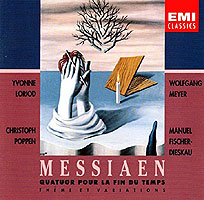
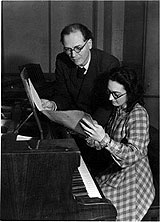 Messiaen and Loriod |
Taken together, the composer's and Loriod's recordings clearly suggest that, despite its formidable challenges, the Quatuor, in essence, is deeply humanistic music that both invites and demands that artists apply their own individuality toward a meaningful performance.
- Marie-Madeline Petit (piano), Guy Deplus (clarinet), Huguette Fernandez (violin), Jacques Neilz (cello) (Erato, 1963)
- Daniel Barenboim (piano), Claude Desurmont (clarinet), Luben Yordanoff (violin), Albert Tétard (cello) (Deutsche Grammophon, 1978)
- Quatuor Olivier Messiaen: Jean-Claude Henriot (piano), Michel Arrignon (clarinet), Alain Moglia (violin), Réné Benedetti (cello) (Cybelia, 1987)
I'm listing these together, as all three boast a direct, albeit somewhat attenuated, association with the composer. 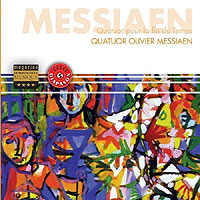
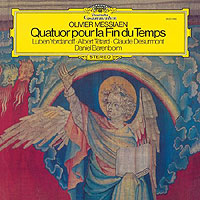
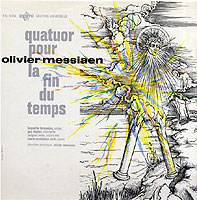 Although little information seems available for its artists, the 1963 Erato LP lists Messiaen for "Direction artistique" right after the soloists and its liner notes comprise an expansion of his preface and thus provide additional valuable insight. The 1978 DG LP states that the recording "took place in the presence of the composer and was authorized by him" and displays a picture of Barenboim studying the score with Messiaen. The pianist of the 1987 Cybelia CD studied with Loriod; the artists formed the "Quatuor Olivier Messiaen" and toured the Quatuor extensively to honor the composer's 80th birthday; and with Pierre Boulez they were founding members of the Ensemble intercontemporain, perhaps the foremost permanent group devoted to modern European music. The 1978 ensemble is somewhat eclectic (although he established an international career Barenboim is Argentine/Israeli and Yordanoff is Bulgarian) but the other ten artists all are French and thus stem from the same musical tradition as the composer. The Erato recording in particular reflects the quintessentially smooth, sweet and blended interpretive approach which we often tend to associate with French chamber ensembles. The Quatuor Olivier Messiaen offers more varied textures and dynamics. Despite its ostensible credentials, the DG recording seems disappointingly labored, perfunctory and aloof.
- Tashi: Peter Serkin (piano), Richard Stolzman (clarinet), Ida Kavafian (violin), Fred Sherry (cello) (RCA, 1976)
One more, if only because, at least in America,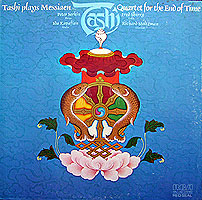 this is the recording that introduced many of us to the splendors of the Quatuor, and of Messiaen as well. Formed by Sherry and legendary pianist Rudolf Serkin's son, Tashi (named after Peter's dog) was comprised of young enthusiasts (only 21, 24, 26 and 31 at the time of the recording), made the Quatuor its signature work and garnered ecstatic reviews. Their focus shows – boasting superlative musicianship, they radiate a tangible feeling of youthful exploration and zeal. Clean and modern, it casts aside preconceptions of past interpretive approaches, although possibly at the risk of seeming objective and even slightly cold (notwithstanding an Abîme with a splendidly improvised quality). Overall, Tashi seems to look not backward to the wrenching time of the Quatuor's creation but ahead to music of the future that, for better or worse, lauds precision over personality.
 Beyond its historical significance, its technical innovations and even the compelling circumstances of its creation, the Quatuor poses the underlying issue of assigning explicit meaning to purely instrumental music. Even without the intrinsic texts of opera, oratorio and song, some non-vocal works (Tchaikovsky's 1812 Overture, Beethoven's Wellington's Victory, Strauss's Till Eulenspiegel)
  can still function as illustration while others ( Debussy's La Mer, Chopin's "Raindrop" Prelude, Beethoven's "Pastoral" Symphony) are sufficiently evocative to conjure powerful mental images. But it seems fair to ask: Are abstract pieces enhanced or cheapened by knowing the precise vision that might have prompted the composer and which he sought to convey? Is the wondrous power of music expanded or restricted by imposing or even merely suggesting a literary program or single significance rather than enabling each listener to respond individually according to one's unique experience, personality, outlook and intuition?
Music is direct communication from artist to listener, soul to soul. While Messiaen's prefatory texts are intriguing, his music must stand on its own to stimulate our imagination in ways that transcend any particular connotation. Messiaen clearly recognized that his initial audience contained few, if any, men who could appreciate the finer points of his work (especially upon a single hearing), much less foresee its vast future import. Rather (recalling Messiaen's proud claim that "never have I been heard with as much attention and understanding"), their reception must have stemmed largely from its emotional resonance. Tellingly, Messiaen ended his preface to the score by conceding, with reference to his religious inspiration, that: "Given the awesomeness of the subject, all of [his description] serves merely as inarticulate and tentative explanation!" So while Messiaen's texts are enticing and each movement exemplifies a salient aspect of his novel theories and personal esthetics, the lasting and ultimate impact of the Quatuor is one of intensely human expression.
 I have primarily relied for this article upon three books that complement each other to provide a comprehensive opportunity to probe more deeply into the background and significance of the Quatuor.
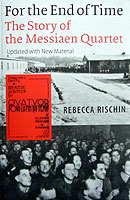
Rischin, Rebecca: For the End of Time – The Story of the Messiaen Quartet (Cornell University Press, 2003; revised 2006). A professional clarinetist, Rischin conducted extensive research and interviewed colleagues and survivors to flesh out the human aspects of subsistence in the Stalag and all four musicians' prior and subsequent lives and careers (and in the process she sorts through and often rebuts many well-intentioned myths, some perpetuated by the composer).
 The result is a deeply moving testament to the personalities and internal forces that infused the work and to its impact upon those whom it touched so deeply. (Don't confuse her achievement with The Miracle of Stalag 8A: Beauty Behind the Horror, a 2010 novelized account with invented dialog.)
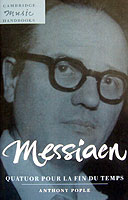
Pople, Anthony: Messiaen – Quatuor pour le fin du Temps (Cambridge University Press, 1998). While Rischin makes bare mention of the music itself, Pople devotes individual chapters to detailed analyses of each movement. Frankly, much of it soars well above my level of interest or understanding, but even on a fairly superficial plane it cannot fail to impress with the many levels of musical organization and thought that listeners might not even realize are operative beneath the readily audible surface.
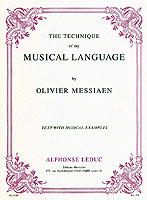
Messiaen, Olivier: The Technique of My Musical Language (Tr.: John Satterfield; Alphonse Leduc Editions Musicales, 1944/1956). In this remarkably compact and straightforward volume the composer himself explains in a mere few dozen pages his theories of rhythm, structure, melody, mode, chords and harmony. Tightly integrated with a companion volume of 382 musical examples that draw heavily upon the Quatuor, it affords a fascinating opportunity to delve directly into the mind of its creator, while offering a lucid and convincing explication of his fundamental musical principles and in the process challenges many of our conventional approaches and familiar assumptions.
Other resources I used (and have quoted here) to supplement those three books:
- Burkholder, Peter, Donald Jay Grout and Claude Palisca: A History of Western Music (7th Edition) (Norton, 2006)
- Evans, Peter: "Music of the European Mainstream," article in the New Oxford Dictionary of Music, Volume X: The Modern Age (Oxford, 1974)
- Griffiths, Paul: "Messiaen, Olivier," article in Stanley Sadie and John Tyrrell, eds.: The New Grove Dictionary of Music and Musicians (Macmillan, 2001)
- Griffiths, Paul: Olivier Messiaen and the Music of Time (Cornell, 1988)
- Hodier, André: Since Debussy – A View of Contemporary Music (Grove Press, 1961)
- Linton, Michael: "Music For the End of Time" (The Institute on Religion and Public Life, November 1998) (https://www.firstthings.com/article/1998/11/004-music-for-the-end-of-time)
- Messiaen, Olivier: notes to the Fernandez/Deplus/Nielz/Petit Quatour LP (Erato STE 50156, 1963); English translation by Helen Baker on Musical Heritage Society reissue (MHS 978, 1981)
- Morgan, Robert P.: Twentieth Century Music – A History of Musical Style in Modern Europe and America (Norton, 1991)
- Ross, Alex: "Revelations: Messiaen's Quartet for the End of Time" (The New Yorker, March 12, 2004)
- Ross, Alex: The Rest is Noise – Listening to the Twentieth Century (Farrar Strauss & Giroux, 2007)
- Samuel, Claude: Olivier Messiaen – Music and Color – Conversations with Claude Samuel (Tr.: E. Thomas Glasow; Amadeus, 1986)
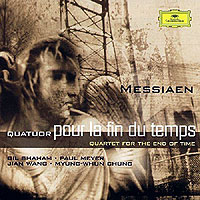

Copyright 2018 by Peter Gutmann







copyright © 1998–2018 by Peter Gutmann. All rights reserved.