Fritz Busch (1890 - 1951) – Beethoven: Leonora Overture II; Mozart: Symphony # 36 ("Linz"); Mendelssohn: Symphony # 4 ("Italian"); Brahms: Tragic Overture; Symphony # 2; Haydn: Sinfonia concertante; Struass: Don Juan.
I hope it's not a subconscious reflection of my antipathy to our namesake president, but this is a weak collection that discredits its subject. 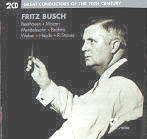 Busch deserves to be remembered for his pioneering and deeply humanistic Glyndebourne Festival Mozart opera recordings of the mid-1930s (recently reissued by Naxos). The sensitivity of his 1936 London Don Juan here hints at Busch's fine work in that era. But all the other recordings are from the last four years of his life and unwittingly illustrate an important point. While the Leonora briefly flickers to life, the rest of these performances are good, solid, middle-of-the-road, competent readings, but nowadays that's just not much of a compliment – cruel, perhaps, but reflective of how far our musical culture has changed in the last century. When the only way to hear music was in live concert, the mere rarity of the experience was thrilling enough and the effort to produce even a minimally proficient performance deserved to be saluted. But with the advent of broadcasting and records our listening habits have shifted radically and the competitive stakes have risen considerably. Now we routinely immerse ourselves in performances that defy time and geography and the giants of the past are no longer relegated to memory but remain fresh and immediate to perpetually challenge all who would follow. Busch's late records are good but they're eclipsed by the superstars who provide that extra spark of care or inspiration. Sorry, but on the basis of this collection he simply doesn't belong in such rarified company.
A parting thought – the producers of the Great Conductors series were kind enough to answer my email inquiries. I feel compelled to mention this because it was an amazingly rare courtesy amid the aloof arrogance that has come to typify the attitude of so many of the major players in the record industry nowadays, an attitude which, as many readers of this site have expressed to me in frustration, is deeply resented. It's also ultimately self-defeating, as it alienates the most eager consumers in whose wallets the future of classical music retailing will rest. Anyway, it appears that the series has now come to its end. I'll continue to cherish most of the volumes, but at the same time I'm saddened that such an ambitious project now seems destined to stop short of being comprehensive, without Abendroth, Bernstein, Horenstein, Jochum, Knappertsbusch, Mengelberg, Paray, Solti, Strauss and others who, in many cases, were far more influential and produced a far more distinctive catalog of recordings than some of those who have been included. But despite my mixed feelings about the subjects and contents of some of the releases, I'm deeply grateful to have them at all, and so I must conclude by urging you to acquire them yourself, reach your own judgments and, above all, make your own discoveries.

Copyright 2003 - 2004 by Peter Gutmann





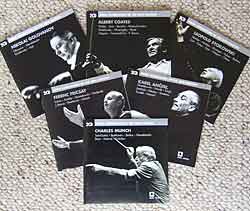 the truncated result is tinged with regret for what might have been. Even so, the edition stimulates many thoughts, not only about its particular subjects but of trends and issues that transcend the specific contents.
 the volumes present a mix of acknowledged giants (Walter, Stokowski, Klemperer) and more obscure but deserving talents (Coates, Talich, Golovanov, Munch). One aspect of the edition that can't be disputed, though, is the fine presentation. Each 2-CD volume is mid-priced (with the final sets two-for-one), well-transferred, efficiently packed into a compact slimline box inside a slipcase, enhanced with cogent and informative liner notes, graced with striking black and white portraits, and dignified with a uniform and elegant graphic style. To the frustration of those of us in the cultural backwater of the US, though, our release schedule had lagged about six months behind Europe. (The reason for this escapes me – in our age of multinational retailing, perhaps the reason why US sales seem depressed is that by the time material becomes available in America enthusiasts already will have bought their selections from e-tailers and overseas distributors, thereby only worsening the perception that US classical consumers are withering away.)
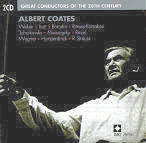 All have an ardent urgency and an improvisatory feel that some may find crude, uncultured and downright immature, but thrill me beyond words. Yet, the ensemble nearly always remains cohesive, no easy task. It's hard to judge whether the consistent excellence of his records was a matter of unwavering quality or just the luck of being able to record only works that genuinely stimulated his enthusiasm. The only downside to this approach, though, is that over time and repeated hearings the edge of excitement and surprise tends to dissipate into mannerism, but the initial exposure is indeed an experience to savor. For that, there's no better place to start than the astounding 1929 account of the Tristan Love Duet, one of the greatest recordings of all time. Begun in Berlin and finished in London with a different orchestra four months later, it begins at full boil and never relents as Coates kindles the fervor of Melchior and Leider in their matchless prime, ending in a climactic orgy that still terrifies with its sheer raw violence. Also from 1929 is a riveting Borodin Symphony # 2, a splendid work that's short, intensely melodic, with a wide range of mood and deserves to be far better known. In comparison to the usual straight-forward readings (of which
 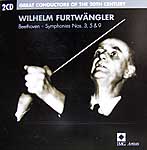 Others surely agree, as is evidenced by a constant flood of LPs and now CDs of “new” Furtwängler releases. Yet, with few exceptions, most repackage – and occasionally reprocess – the same material as before. Thus, a prospect of genuine newly-found performances of his core repertoire promises to be a major event. This volume is a fabulous collection, even though it isn’t quite what it purports to be. Furtwängler’s wartime concerts project his frighteningly intense struggle between pure artistic truth and sordid political reality, soaring human aspirations and appalling social depravity. Nowhere is this more distilled than in his Beethoven and especially in the symphonies heard here. Until now we’ve had only a single Fifth from this era (June 1943) but the producers claim to have found another from February 1944, when Furtwängler’s emotions were screwed even tighter. Alas, beyond identical timings, every cough and glitch (of which there are amazingly few) are the same. So instead of the promised find, all we have is yet another reissue of the familiar version (regardless of whether, as previously identified, it was from 1943 or, as now corrected, 1944), albeit in a richer and more powerful transfer than ever before. (Its previous best incarnation is in Maggi Payne’s 1999 restoration in Music and Arts CD set xxx.) Even so, this is a stunning performance, my favorite of all the dozens of Beethoven Fifths I’ve heard. The allegro con brio treads a perilous balance between resolute hope and grim despair, the scherzo is downright malevolent and comes to perch on a excruciating suspended brink of desperation, and the triumphant finale is suffused with anger and doubt and drained of any sense of fulfillment. The coda is devastating in its edgy ambiguity – accelerating with sheer mindless energy far too rushed for any sense of comfort, and then winding down to leave the final chord an exhausted and resounding question mark. The Eroica here does seem truly new and it’s mesmerizing, vaulting to the top of my personal list. If the producers’ attribution to February 1954 is correct it would be the last of Furtwängler’s recorded Eroica performances. While just missing the subtle nervous tension that made his 1944 Vienna recording uniquely compelling, it’s a superb melding of the sensitivity of his Berlin Philharmonic work with the smooth subtlety of the Vienna Philharmonic into an intensely human document. Its exquisite attention to detail elucidates the structural components within the overall architecture and is conveyed through a remarkably sharp, well-balanced recording (and with a fortunately quiet audience). The Ninth is the earliest of Furtwangler’s dozen. The producers’ claim that it was only available in Japan ignores the 1994 Music and Arts edition (CD 818), but here the oversight is gladly forgiven, as the transfer is vastly better – still several degrees below hi-fi, but now good AM rather than short-wave quality and with far more mid-bass (and, alas, annoying rumble that should have been filtered) that compels a re-evaluation on artistic terms, as it now resembles listenable music rather than a merely curious primitive artifact. Frankly, there are more compelling Furtwängler Ninths – a frightening 1943 Berlin concert drenched with pain and agony, a 1951 Bayreuth dedication in which the slashing wartime ferocity yields to heartfelt humanistic triumph, and a luminous 1954 Lucerne Philharmonia performance. Yet, all the elements of Furtwängler’s unique way with this work are firmly in place in this May 1937 Berlin Philharmonic London concert, from a barely audible opening to a vertiginous coda – indeed the ending is more startling than he would ever achieve again. Despite disappointment over the “new” Fifth, this is a fabulous collection both for devotees and for those eager to discover why Furtwängler is still able to muster such enthusiasm a half-century after his demise.
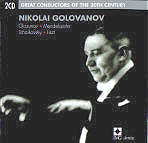 Among its services is the perpetuation of the art of musicians who were barely known in their time outside their own immediate spheres of influence. Golovanov surely was among these. Although he was the dominant force in Russian opera for nearly thirty years, he was summarily purged in 1952 (literally refused admission to his opera house one morning), died the following year and was conveniently forgotten as a political imperative of Soviet rewriting of Russian cultural history. Only recently have his records resurfaced to reveal an extraordinary outsized personality, a visionary galaxies apart from the polished discipline of Mravinsky and others who better towed the party line, both politically and aesthetically, and whose art has been touted as representing the Soviet ideal. Over half this set is devoted to five Liszt tone poems from Golovanov's pioneering set. While in most other hands they can seem ploddingly empty bombast, here they spring to life as tantalizingly fresh. Much the same can be said of the otherwise instantly forgettable Glazunov symphony. But the most sensational surprise is a staggeringly intense 1812 Overture, the tiresome old warhorse which Golovanov gooses to life with a wild, uninhibited, over-the-top, electrifying account (although, for purposes of political correctness, the climactic quotation from “God Save the Czar” is replaced by a fragment of Glinka). Other proof of Golovanov's unique talent is on a dozen Arkadia CDs that include his magnificent Scriabin symphonies, more Liszt, Wagner excerpts and even Grieg lyric pieces, all of which he brilliantly transforms with ecstatic fervor.
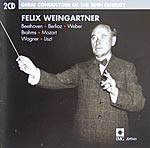 But that’s only a starting point for appreciation, as his records have extraordinary intrinsic merit. Weingartner’s career is firmly founded in the Romantic age – he played for Brahms, studied three years with Liszt and replaced Mahler at the Vienna Opera. Reportedly his early conducting reflected the deeply personal proactive manner of that era (a remnant can be seen in a 1932 movie of him leading the Weber Freischutz Overture on the Art of the Conductor video, Teldec 95038). Yet, more than any other conductor (including Toscanini), he launched the modern objective style that dominated the 20th century. “Objectivity” can be deceptive, though – just listen to the Mozart here, gleaming with freshness, its essentials clearly displayed – and compare it to the soulless Toscanini recording (BMG 60285). As described in the fine notes by Christopher Dyment, Weingartner stridently rebelled against the norm of his time to found a style of restrained elegance using a basic steady rhythm with subtle variations that achieved a remarkable degree of flow and integration. That’s not to say his work was dull – his Beethoven Fifth (Naxos 110956) is quite a distinctive blend of relaxation and strength, his Eroica has huge (but smooth) tempo swings and his Brahms First (EMI 64256), while shorn of rhetoric, is full-blooded and hugely potent. His style works for a wide variety of material – he consistently finds just the right texture and keeps all the elements in a confident balance that invites you into the composer’s world. The only regrets are that while Weingartner recorded prolifically, this set is limited to EMI material from his final years and that the Beethoven and Brahms duplicate readily available CDs, although the transfers here are more detailed, if a bit falsified with electronic gloss from the truer resonant 78 sound heard on Naxos 110856 and EMI 64256. Even so, the Symphony # 2 should be cherished as the culmination of the very first complete Beethoven symphony cycle on record and the Brahms is an object-lesson in the virtue of being simple without becoming simplistic. The Wagner Rienzi Overture manages a rare miracle of avoiding hysterics while maintaining a gripping and dramatically-valid pacing throughout. The Liszt, too, is shorn of bombast yet pulses with vitality. The Weber is especially interesting because it’s in Weingartner’s own arrangement, beginning and ending with the same cello solo as the famous Berlioz version but more heavily orchestrated (even including percussion and a tambourine) yet quite effective (which can’t be said for his more notorious overboard instrumentation of the Beethoven “Hammerklavier” Piano Sonata, which he conducts on Pearl 9358). Indeed, the Weber serves as a reminder that Weingartner was far more than just an influential conductor – he wrote nine operas and seven symphonies, as well as authored treatises on conducting and the Beethoven symphonies. All in all, this is a wonderful collection that should help preserve the memory of one of the most overlooked but important musicians on record.
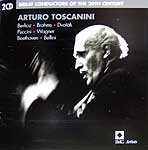 A reliable or even clearly defensible answer is impossibly subjective, of course, but the most influential conductor surely was Toscanini. A half-century ago, he was the god of classical music – called simply “the Maestro,” as if there could be no other. Yet, nowadays it’s often hard to hear why. As I’ve detailed
 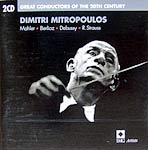 and instead squandered the entire first disc on a performance that’s readily available elsewhere. Yet, not only is this 1959 Koln Sixth one of the greatest Mahler performances on record, but its sound is so vastly improved over previous incarnations as to substantially augment its riveting impact. Here, one of Mahler’s foremost advocates, at the very top of his form, displays how he galvanized the young Leonard Bernstein into becoming both a conductor and perhaps the greatest Mahler activist of all. Yet, unlike Lenny’s own deeply committed Mahler odyssey, here there’s not a drop of schmaltz, hyperbole or overt visceral emotion. Rather, Mitropoulos’s conception is one of pure, searing focus – taut, spare, seething with tension and driven relentlessly forward with unremitting intensity. The playing of the Koln Radio Orchestra is inspiring and astounding, boosting the conductor’s concentration by sustaining his precision and energy throughout all 75 minutes of this exhausting score, which perhaps strains an ensemble with more sheer sustained volume than any other. Mitropoulos left us many fine performances, but this one is truly special and begs to be heard, cherished and preserved in this superb restoration. The 1950 NY Philharmonic La Mer benefits from a similar conception of vitality amid discipline. Yet, despite some shaky ensemble at the climactic close of the first movement, a Koln account recorded at Mitropoulos’s penultimate concert on October 24, 1960 (Arkadia 753) is even more impulsive, atmospheric and overtly dramatic – plus, it’s more clearly recorded. Mitropoulos’s Berlioz followed firmly in the stylistic footsteps of famed British conductors from Halle and Harty through Beecham and Davis – civilized but dynamic, with rather muted power suppressed within the confines of classicism, the intensely lyric passages nicely integrated into the whole rather than serving as respites amid outbursts of violence. Curiously, though, the extended Romeo and Juliet suite here ends with the “Reveil de Juliette,” which leaves the descending oboe figure to linger inconclusively rather than to segue into the finale’s fanfares and choruses that follow in the score. And the "Love Scene" is afflicted with a periodic dimming of the harmonics that suggests partial erasure of the source tape, an affliction which fights the effect of the sustained notes and the placid atmosphere. Otherwise, alongside a 1957 NY Philharmonic stereo Symphonie Fantastique (no CD) and a 1957 Koln Requiem (Arkadia 562), it’s a fine representation of Mitropoulos’s affinity for Berlioz. Finally, the 1956 Strauss with the New York Philharmonic is sharp and piercing, far more teasing and ultimately frightening than sensual – indeed, it’s hard to imagine such a rendition reintegrated into the opera from which it is extracted, as it would obliterate any impact of the dance it’s intended to accompany.
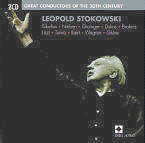 during all but the first decade of his nearly 70-year podium career. Faced with such a vast legacy, the producers have managed a fine collection (although it doesn't begin until the LP era), including material new to CD. Of greatest interest are the Brahms and Sibelius, among Stokowski's last recordings, made in his 95th and 96th years. Far more than a geriatric stunt, the Sibelius defies Stokowski's age by combining his trademark color with astounding dramatic intensity – the opening is seeped in mysticism, the insistent tympani figures of the scherzo scorch with savage force and the meandering structure is constantly fused with a focused vibrancy. The Scandinavian journey continues with Stokowski's only Nielsen (previously only available on a private LP), played by the Danish Radio Symphony with the same rich, deeply burnished sound Stokowski drew from all his orchestras, testimony to his leadership powers. It's also typical of this remarkable man, whose thirst for new experiences never slackened, that he first played this score at age 85. (If only Stokowski had taken up the Nielsen Third (the “Sinfonia Espansiva”), seemingly custom-tailored to his strengths!) The final major item here is one of Stokowski's many attempts to distill an entire Wagnerian act or opera into a half-hour symphonic synthesis, here with the last half of Tristan. While purists still cringe, these cavalcades made Wagner accessible to the legions who wouldn't be caught anywhere near an opera house; among his many other roles, Stokowski was a great educator. The remainder of this collection is given to manifestations of the Stokowski recipe of making exotic classical lite fare seem like a filling high-calorie treat.
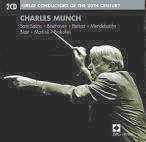 While Munch's French repertoire – and especially his Berlioz – is praised, his other work is often dismissed as superficial. Typical is Harold Schonberg's jab in The Great Conductors: “Munch seems rather impatient in German music, where his tempos tend to be very fast and where the expression can be perfunctory.” (Couldn't the same be said for Toscanini, whose similar style is venerated?) In any event, I disagree. Raised in Alsace, Munch was immersed in German culture and his records of Schumann, Brahms, Mendelssohn and even the Beethoven Eroica (all on BMG Gold and Silver Seal CDs) are superb. While it's hard to describe Munch's interpretive approach, perhaps he put it best in his 1954 autobiography, where he described himself as reserved, shy and withdrawn but “seeking to fulfill his dreams through sound. You have to let your soul tremble to sing out your emotions.” Moss Hart aptly deemed Munch as “inspiration with elegance.” Munch never went for the grand gesture that would call attention to himself as a dominant leader, but rather contented himself with being an invisible force to draw the music out with precision allied with vast energy. The end of his Beethoven Ninth makes you feel great about the music and thankful that Munch and his forces let it speak for itself. The most important work here is Martinu's vibrant Symphony # 6 (“Fantasies symphoniques”), which the composer wrote specifically for Munch, whom he characterized as having “a spontaneous approach … where music takes shape in a free way. An almost imperceptible slowing down or rushing up gives the melody a sudden life.” Munch's performance is definitive. Also welcome is a sublimely eloquent statement of the Bizet Symphony in C that trades some of the grace of Beecham's acclaimed earlier version with the same orchestra for a dollop of oomph entirely appropriate to the youthful work.
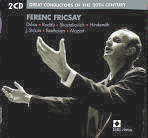 This volume is a wonderful remembrance of live recordings. Of particular interest are those from his brief 1961 Indian Summer between illnesses. The Beethoven Eroica is revelatory, taken far slower than even Klemperer or Furtwangler, but trading their respective somber gravity and metaphysical rumination for a startling sense of spirituality, a vision of clarity purified by a glimpse of looming mortality and abetted by a tangible bond between the conductor and the Berlin Radio Orchestra, which he led through most of his abbreviated career. The Leonora, too, is charged with a limpid radiance, unfolding with exquisite patience, its trumpet call suspended in eternity. Fricsay considered Kodaly not only his teacher but the embodiment of Hungarian culture; this 1961 Dances of Galanta, slower and more inflected than his fine 1953 studio version, serves as a final testament to his mentor. Fricsay reveled in modern works; his extroverted Shostakovich Ninth displays his affinity for the Slavic style, while the Hindemith was the first work he performed with “his” orchestra. The Dukas provides an appropriate bookend, as it was his very last recording. Transparent Strauss and vibrant Mozart round out a fine portrait of a versatile and consummate musician who consistently brought out the best in everything he touched.
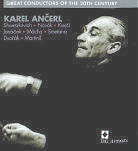 The only member of his family to survive the Holocaust, his unstinting devotion to the culture of his beloved Czechoslovakia was repaid by being driven into exile upon the 1968 Communist occupation. But throughout was a constant allegiance to music, whether as the founder of a string orchestra in the ghetto, his service for 18 years as head of the Czech Philharmonic or his final role as a centerpiece of the Toronto musical scene. The present selection symbolizes highlights of his musical life, including his first recording (the Novak), a guest stint in Amsterdam with the Concertgebouw (a Dvorak Eighth that's rich and flowing yet focused and full of nuance) and the fine results he achieved in his final post with the Toronto Symphony (a Martinu Fifth with rhythmic vitality galore). While his Moldau and Taras Bulba are fine, so are dozens of others, and thus the gems here are the Macha, Novak and Krejci pieces, all in their only recordings. The Macha is riveting – a striking piece in the tradition of the finest tone poems, unified yet evolving swiftly through a variety of richly atmospheric and edgy moods, a profound and vibrant reflection on the life and early death of a fellow composer and close friend. The Novak and Krejci are light and rather unexceptional but deserve to be heard. And after all his struggles, if that's the type of music Ancerl enjoyed, to bring some joy and light into a world whose sorrows and darkness he knew first-hand, who are we to argue?
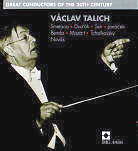 owing to local origins and deep roots in being raised in the idioms of their culture, tireless service to the musical life of their country and recognition and plaudits bestowed by native cultural leaders. To that can be added Talich's rare sense of self-effacement; indeed, he described his approach as combining industriousness, attention to detail and searching for eternal truth. The result was impersonal in the best sense – solid, unpretentious and clear. All the present recordings come from the final phase of his career, after he had battled two purges and fell victim to ill health. Of those I've heard, I generally prefer his earlier, pioneering records – his 1929 Sarka is weightier and more resolute than the 1954 version here, while his 1938 Suk Serenade better captures the youthful naivete of the work. The Dvorak Water Goblin (a live performance) and the Janacek are wondrous and idiomatic. Despite its secure sense of style and usefulness to demonstrate Talich's versatility, the Mozart symphony seems unnecessary, its space better devoted to one of the Suk or other rarities cited in the notes which Talich championed. At first the prospect of yet another New World raised similar qualms, but I gladly admit I was wrong; indeed, it's the gem of the set. For his third and final recording, Talich announced that he would set out to rid the work of rhetoric in favor of conveying its monumental simplicity. That's just what he does. Here is Dvorak by one his foremost disciples and advocates, drawing upon his own similar Bohemian background seeped in a lifetime of experience, and played from the heart by the great Czech orchestra. While no performance of this multi-nuanced work can be deemed definitive, this one comes as close as any.
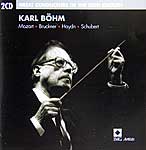 Bohm’s career was “severely disrupted by the Allied victory.” Well, let’s be blunt: Bohm’s post-War fame arose only once the world sloughed off the slimy residue of his enthusiasm for the Nazis to rebuild a career that had been founded upon shameless opportunism. He then developed a reputation as reliable, stable and attentive to detail, exemplified by his acclaimed opera recordings from Mozart to Berg, of which the Cosi overture here is an apt representation – judicious, steadfast tempos that keep all the elements in a comfortable balance. While a highly effective approach in such a finely-textured and keenly-structured work where an injection of strong personality might seem an intrusion, many of Bohm’s orchestral studio recordings seem a bit too well-groomed – the 1973 Vienna Philharmonic Haydn here may gleam with formal perfection and remarkably transparent textures yet emerges as rather dull, shorn of the humor and vigor claimed by the notes and found elsewhere. But as with so many other conductors, more interesting elements of personality emerge in concert than in the studio. The Bruckner Eighth, a 1974 Cologne Radio Symphony “live studio recording” (which I take to mean taped continuously but without an audience) is magnificent – a rich, powerful and superb realization of the Schalk version, the equal of any within the no-nonsense German tradition (that is, brimming with heady self-assurance while making no pretense of the daring fantasy of Furtwangler or the visceral excitement of Horenstein). The Schubert, too, is a gem – a truly great performance of the “Great.” Made in Bohm’s 85th year, it bristles with creative energy. The Dresden Staatskapelle (the vehicle for Bohm’s early fame when he replaced the more principled Fritz Busch in 1934) plays magnificently, placing precise accents within an overall warm texture. Bohm infuses the first movement with ample tempo variation, but with effortless transitions that breathe a natural vitality. But just to remind us who’s in charge, just as it’s about to wrap up he doubles the strings’ penultimate statement of the main theme with blaring brass – a startling but logical and highly effective touch. So often the second movement is little more than a space-saver between the drama of the opening and the strengths to come, but here it surges ahead with brisk pacing, strongly-articulated structural divisions and constant tension between the essentially light wind-dominated atmosphere and the sharp string/brass outbursts that rend its sonic fabric. In an unusual tack, the third movement thickens the texture and darkens the tone, rendering both scherzo and trio pensive rather than joyous and saving energy for the finale to follow. When the finale does arrive it’s slow and steady with vast energy, its dignified power fueled by huge tympani accents, a worthy capstone to a career
whose glory is too often obscured by the routine of studio product.
Bohm’s career was “severely disrupted by the Allied victory.” Well, let’s be blunt: Bohm’s post-War fame arose only once the world sloughed off the slimy residue of his enthusiasm for the Nazis to rebuild a career that had been founded upon shameless opportunism. He then developed a reputation as reliable, stable and attentive to detail, exemplified by his acclaimed opera recordings from Mozart to Berg, of which the Cosi overture here is an apt representation – judicious, steadfast tempos that keep all the elements in a comfortable balance. While a highly effective approach in such a finely-textured and keenly-structured work where an injection of strong personality might seem an intrusion, many of Bohm’s orchestral studio recordings seem a bit too well-groomed – the 1973 Vienna Philharmonic Haydn here may gleam with formal perfection and remarkably transparent textures yet emerges as rather dull, shorn of the humor and vigor claimed by the notes and found elsewhere. But as with so many other conductors, more interesting elements of personality emerge in concert than in the studio. The Bruckner Eighth, a 1974 Cologne Radio Symphony “live studio recording” (which I take to mean taped continuously but without an audience) is magnificent – a rich, powerful and superb realization of the Schalk version, the equal of any within the no-nonsense German tradition (that is, brimming with heady self-assurance while making no pretense of the daring fantasy of Furtwangler or the visceral excitement of Horenstein). The Schubert, too, is a gem – a truly great performance of the “Great.” Made in Bohm’s 85th year, it bristles with creative energy. The Dresden Staatskapelle (the vehicle for Bohm’s early fame when he replaced the more principled Fritz Busch in 1934) plays magnificently, placing precise accents within an overall warm texture. Bohm infuses the first movement with ample tempo variation, but with effortless transitions that breathe a natural vitality. But just to remind us who’s in charge, just as it’s about to wrap up he doubles the strings’ penultimate statement of the main theme with blaring brass – a startling but logical and highly effective touch. So often the second movement is little more than a space-saver between the drama of the opening and the strengths to come, but here it surges ahead with brisk pacing, strongly-articulated structural divisions and constant tension between the essentially light wind-dominated atmosphere and the sharp string/brass outbursts that rend its sonic fabric. In an unusual tack, the third movement thickens the texture and darkens the tone, rendering both scherzo and trio pensive rather than joyous and saving energy for the finale to follow. When the finale does arrive it’s slow and steady with vast energy, its dignified power fueled by huge tympani accents, a worthy capstone to a career
whose glory is too often obscured by the routine of studio product.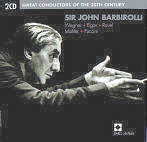 and a highlight of the entire series, is a hitherto unheard Mahler “Resurrection.” A latecomer to Mahler, Barbirolli made only two studio recordings of Mahler symphonies (the Fifth and Ninth), both highly acclaimed. While sixties concerts of others have since emerged, this is a true find, given in Stuttgart only three months before his death. There's an inspired performance here yet it struggles to surface, smothered by rough and occasionally awful playing. Barbirolli's finest recordings radiate a menacing, nervous intensity which seems to have stirred the players and would have emerged with even greater subtlety and splendor if only the mechanics were more secure. Already quite ill, Barbirolli perhaps couldn't inspire with his accustomed intensity and often a strikingly subtle effect is quashed beneath a wincingly sour lapse of ensemble, articulation or rhythm. Although the worst disaster (presumably a miscue from the conductor) compromises the final climax when the entire brass section misses a key entrance (disc 2, track 10, 3:36), things do generally tend to settle down as the work progresses. Indeed, while most orchestras tire as they proceed through a live performance of this exhausting evening-length piece, the opposite occurs here, as the forces seem to coalesce and subtle details begin to emerge as the work proceeds. Overall, Barbirolli imparts a rare spontaneous feel that leaves a wholly modern impression of uncertainty and misgiving. If Klemperer's “Resurrection” ends in a period and Bernstein's an exclamation point, Barbirolli opts for a question mark.
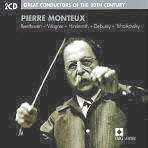 his reputation was as the most cosmopolitan of conductors, who could convey all music convincingly. The only disappointment here is the Debussy Nocturnes – not for any shortfall in the performance (although the sound is frustratingly dim for its 1955 vintage) but because it's readily available in the BMG Pierre Monteux Edition. All the other selections make their CD debut. The most welcome is the Tchaikovsky Sleeping Beauty excerpts (about a third of the score, including most of the favorite “hits”), one of Monteux's few major stereo LPs never before reissued (still missing are the Sibelius Symphony # 2, Haydn "Surprise" and "Clock" Symphonies and the Brahms Violin Concerto with Szeryng). Despite his extensive background with the Ballets Russe (where he led the world premieres of Petroushka, Sacre de Printemps and Daphnis et Chloe) Monteux's conception is more symphonic than balletic, functioning more as abstract music than support for stage action. Thus, his sudden tempo shifts in the famous Act I valse seem apt to detract attention from the dance and the carillon of clanging bells in the prologue seems more frightening than evocative of singing canaries. The Beethoven Symphony # 2 is surprising, full-bodied but with a sonority that portends the equivalence between string and wind balance that would emerge only later in “original instrument” performances. The 1964 Hamburg Wagner is lean and flowing, a nice complement to the scrappier live 1951 San Francisco Orchestra version on Music & Arts. The Hindemith sounds unusually opulent and serves to document Monteux's way with a favorite score which he never recorded, heard here in a live 1962 Copenhagen concert.
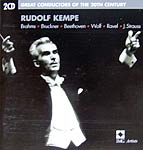 of mostly German repertoire, only to be overlooked after his death. Along with the reissue of his extensive Strauss series on EMI and a recent infusion of CDs from the Testament and BBC Classics labels, the major works here are well-chosen to help restore luster to our memories of his career. His 1972 Bruckner Fourth leavens solid German sobriety and weightiness reminiscent of Klemperer with impulse and a vivid texture that belies the deliberate tempos, all with the same Munich Philharmonic that would produce such dense, steadfast and deeply spiritual readings only a decade later for Celibidache. The finale, in particular, charges ahead with startling force. The Eroica is heavily romanticized, but more as a matter of shifting textures than of the standard means of adjusting tempo and dynamics (although there’s plenty of that, too) – in the first movement the brass punch out their emphatic repeated climactic chords and the strings entice with their decorative figures while the winds provide an anchor of stability. In the scherzo, nominally the simplest movement, Kempe toys with our expectation of constant forward motion (and accentuates the humor) with surprising and exaggerated shifts of tempo and horn and string accents in the trio. His finale fully characterizes the variations, but weaves them into an organic fabric that extols the cohesion and progression of Beethoven’s structural thoughts. The same logical rigor underpins the scintillating detail of the Wolf, transforming lightweight fluff into a miniature masterpiece. The Brahms is a fine reminder of Kempe’s abiding strength with solid and thoroughly convincing readings of the core German repertoire. The pedestrian Daphnis et Chloe, though, seems unnecessary – the notes valiantly try to boost it as a rare performance with chorus, but there are plenty of others, including a version by Markevitch included in his volume of this very series!
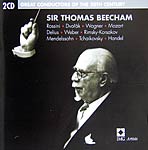 This isn’t the place to debate Beecham – either you vaunt him as the epitome of refined and impeccable taste, or deride his pompous ego and superficial interpretations. Beecham began his career as a dilettante – he didn’t yet merit an orchestra on the basis of talent or experience, so he used his family’s vast wealth to buy one. On one of his earliest records, a Columbia 78 issued around 1915, the Beecham Symphony Orchestra plays an abridgement of Borodin’s Polovtsian Dances; even allowing for the mechanical and esthetic limitations of the acoustical process and the well-worn condition of my copy, the playing is awful and the leadership uninspired. Judging from an LP issued by High Fidelity magazine, his rehearsal technique was almost non-existent, inspiring his players’ devotion largely through minimal repetition and loads of jocular stories. Yet, beneath his relaxed demeanor was a focus that somehow managed to yield substance. Some of his work tended toward blandness, but at his frequent best he had an instinct for finding a magic level where emotion was sublimated into purest art, often in unlikely places – Wagner operas (glimpsed here in a Rheingold excerpt) and in the enthralling Tchaikovsky Fourth, a wondrous balance of feeling and grace, passion and control. Most of the symphony is the 1957 mono version already issued on EMI 63380, but the first movement is new, as far as Beecham got in 1958 toward a planned stereo remake. The interpretations are virtually identical, but the mono is more detailed, spared the ringing midrange resonance that blurs most of EMI’s early stereo forays. Beecham even injects a bit of teasing humor into the coda of the finale – it becomes a bit labored only to leap ahead for a final breathless thrust. The 1951 Antar is a worthy companion to the more dynamic 1946 San Francisco set by Monteux, another conductor known for his geniality but who sounded thoroughly convincing in Slavic repertoire. The biggest surprise is the Weber, which hails from a 1935 concert and eclipses his 1936 studio effort (on Dutton 7009). Beecham verbally eggs his players on both in the tightly focused central section and in a conclusion that’s absolutely stunning in its crackling vitality, even trumping Furtwangler’s supercharged 1926 record with the Berlin Philharmonic (on Koch 7059). The Rossini is new in that it’s comprised of first takes cut in July 1934, which Beecham rejected. It’s plain to hear why – despite fine articulation and a slightly more pointed finale, the released October version (on Dutton 5009) has far better balance, with the brass emerging from the earlier murk, although audible tympani would have been welcome. And finally, there’s Delius. Beecham championed him as the last great composer, but I think more of a derivative movie soundtrack in desperate search of interesting visuals. If you really need a third Beecham Appalachia here it is, spirited and beautifully played at the same concert as the Weber, but while this garish treatment of “an old slave song” is pleasant to read by (if you can ignore the violation of its spiritual roots), I’d have preferred a few more of the “lollipops” (an apt term – sweet and forgettable) for which Beecham was famed and which are represented here with short diversions by Dvorak, Mozart, Mendelssohn and Handel.
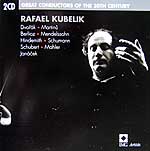 Yet, of the forty conductors included in this series, three hail from Bohemia (now Czechoslovakia) –
  This edition suggests the origins and broader aspects of his career. The most surprising recording is the 1931 excerpts from the Threepenny Opera. Nearly the first half of Klemperer's career was as an opera director, of which the final four years of 1927-1931 at the Berlin Kroll Theatre were marked by daring and innovation. The four pieces from the concert suite which Klemperer commissioned from the composer are wry and dry, fully reflecting the droll wit of the 1930 Telefunken original cast recording far more effectively than Klemperer's dignified 1961 Philharmonia remake of the entire suite. (The same literal approach works less well on other Kroll-era recordings, collected on Symposium 1042, in which a Debussy Nuages, a Ravel Alborada and light operetta overtures scream in vain for atmosphere and a touch of zest.) Although the present volume skips the middle part of Klemperer's career, the 1950s Mozart, Beethoven, Strauss and Stravinsky all provide live alternatives made in close proximity to EMI studio recordings. The comparisons are striking. In the accompanying notes, Alan Sanders makes an interesting observation – that while most conductors use a series of concerts to refine their thinking and prepare for a recording, Klemperer tended to record a work first and only then perform it, thus implying that for him the concert was the more important event. In each case here, the live version is swifter and far more alert to the nuances of the music than the monolithic record (and, curiously, in much better fidelity). (In its Klemperer Legacy series, EMI has issued some of the concerts previously available only on bootlegs, including wonderful Mahler Resurrection, Beethoven Fourth and Fifth, Mendelssohn Third and Bruckner Fourth symphonies.) Of course, Klemperer is still Klemperer and so we're talking of matters of incremental degree – don't expect even a shred of grace in the Stravinsky or youthful energy in the Beethoven. Ironically, though, while perhaps more idiomatic and satisfying, the more mainstream approach of the live cuts takes us away from the sound that made Klemperer's records unique and thus especially cherishable. The only piece new to the Klemperer opus is the Janacek, which he championed but never recorded. It's a good, solid performance if a bit colorless and nondescript, but still nice to have.
 yet inexplicably absent from CD until now. Rich and powerful but free of impulsiveness or excess, it covers a full emotional range and integrates the structure with logic and cohesion by gliding smoothly among well-judged suitable tempos and leaves a warm, satisfying impression of complete planning and empathy. Koussevitzky lavishes the same attention on the Liszt, whose music he championed, as if to elevate it to a pedestal worthy of more substantial music. The Rachmaninov, too, is given a setting of controlled passion, a worthy compliment to the composer's own more objective 1939 Philadelphia account. In seeming contradiction to the producers' avowed intent, the second disc is squandered on material, fine as it is, that's readily available elsewhere. The 1933 live Sibelius, exalted since its initial release, remains not only the first but in many ways the most complete realization of this innovative score that largely evolves from a single germinal idea. Koussevitzky lauded the Harris symphony as the greatest orchestral work ever written by an American, and this recording, made the same year as he gave the world premiere, although technically weak, represents Koussevitzky's unstinting devotion to the musical life of his adopted country. The Beethoven Fifth, in contrast, is all classical elegance and firm control, perhaps showing the conductor's ultimate respect for the venerable music of the generations before his own. (This is the 1934 London Symphony account, strikingly similar to, but a bit more mellow than, his Boston remake.) So while this is a fine collection, it could have gone farther to redress the shameful neglect by BMG/RCA of one of its greatest artists – in the entire CD era, they've issued just a few scattershot CDs of his work. If I were king, my ideal Koussevitzky collection would have been the last three Tchaikovsky symphonies, since his Pathetique is in sore need of better transfer than on BMG 60920 (which in any event is now deleted) and his superlative Fourth seems to have eluded CDs altogether.
 Harking back to the era before conducting emerged as a distinct specialty, most composers led their own work with varying success, ranging from utter disaster (Bruckner) through general respect (Stravinsky and Copland) to wildly triumphant (Liszt). A few, like Strauss and Britten, specialized in their own material but branched out to become credible interpreters of others’ work. But for most conductors, composition was a side-line, ranging from the derivative dabblers (Toscanini’s maudlin early songs) through serious attempts at standard large forms (Klemperer) to those seized with genuine vision (Mahler). But even within this wide range of involvement, Markevitch was unique. The first thirty years of his musical life were devoted entirely to composition and seemed poised for great success – he was hailed by none other than Bartok as “the most striking personality in contemporary music and I rejoice in profiting from your influence.” Indeed, his few compositions that are available strike the difficult balance of achieving refreshing originality without being alienating. But during World War II, after a serious illness, he set aside further composition and determined to become a conductor. It’s hard to ascribe a special style to his work on the podium. In all cases, it’s clear, precise and neutral (in the sense of avoiding personal coloration) without lapsing into blandness. He recorded a superb Tchaikovsky cycle, represented here by a Manfred seething with controlled power and ensuring that this hyper-dramatic score emerges with dignity. The Debussy, too, displays an entirely natural-sounding ebb and flow, with especially smooth transitions, the Verdi is shorn of melodrama, the Chabrier gleams with clear-cut accenting. It’s as if Markevitch, reflecting back on his own former career, pays other composers the ultimate compliment of scrubbing their scores clean of interpretive gloss, even where, as in the Glinka, Strauss and Ravel, they could use just a bit. His work is a form of sacrifice – many conductors claim to let the scores speak for themselves, but their reticence all too often leads to blandness. While Markevitch’s work isn’t distinctive, it stands as a conscious tribute to good music and to his own integrity.
 more by a desire to exploit his extensive EMI catalog than artistic merit. But his credentials are solid. Like Markevitch, Kletzki devoted the first phase of his professional life to composing and turned to conducting after the dislocation of World War II. But while Markevitch’s experience led him to deeply respect the prerogatives of other composers, to the extent of hesitating to add interpretive elements of his own, Kletzki appears to have encouraged his players to actively participate in the creative process by projecting an improvisatory feeling to their work. An associate of Furtwangler, who was famed for his attention to transitions, Kletzki took his mentor’s concern to an extreme, such that his performances draw their strength from constant, smooth modulations, while remaining intensely lyric throughout. Thus, his Brahms Fourth has tempo extremes comparable to Furtwangler’s, but without Furtwangler’s huge injections of brusque dynamic punctuation and riveting tension; rather, Kletzki glides among sections and even phrases so effortlessly that the work glows with vibrant continuity. This is what used to be called “not breaking the line” in the so-called golden age, but here the principle results not in steadfastness and reticence but compelling unity and logic. Kletzki also managed to draw a luminous texture from his orchestras; here, six disparate ones from France, Germany, Czechoslovakia, England and Israel all glow with an inner life – a sure tribute to the skill of a major artist deserving to be remembered.
 as his reputation is inseparable from the ensemble he honed during his final 24 years into an awesome instrument of exquisitely refined precision. Szell was known to boast that they began rehearsing where other ensembles left off. Yet, polishing is an abrasive process and when it’s overdone the essence of even the finest jewel can be worn away. Fortunately, Szell was a master craftsman (if not a brilliantly original creator) and knew how to achieve the effects he sought without deadening the organism of his orchestra. Most of the Szell/Cleveland stereo releases remain available on Sony’s budget Essential Classics line, including their celebrated Brahms and Beethoven symphony and piano concerto cycles. The four short pieces that bracket the major works here are otherwise unavailable remnants of their work and all attest to the sheer pleasure of hearing even modest music played so well. (The 1954 Meistersinger Overture with the NY Philharmonic reflects a similar sheen but with a richer Carnegie Hall acoustic.) Szell’s lean and precise 1958 Cleveland account of his compatriot Dvorak’s Eighth is justly famous and still sounds magnificent on Sony Masterworks Heritage MH2K 63151, but here we have their remake from his final year, just after he and the Clevelanders ended their long-time association with Columbia/Epic for EMI. (The LP included two fine Slavonic Dances, sadly omitted here despite ample room.) Although timings are only slightly longer, the performance trades the sharp, scintillating gleam of the earlier version for a more autumnal feeling, with slight deliberation, deeper emphasis and darker color, but while the fundamental clarity remains, it’s compromised by blurry recording and overload distortion. The Debussy and Tchaikovsky also are remakes of superb Epic recordings, in these cases transplanting their lean precision closer to Szell’s origins with 1962 and 1966 Koln Radio Orchestra broadcasts. The La Mer retains all the precision of Ansermet or Boulez but adds an exciting sense of involvement, and the Tchaikovsky Fifth, hardly lacking for fine interpretations, suggests its emotions from a fresh gleaming palette. While barely distinguishable from the Cleveland accounts, they’re a welcome adjunct to the Szell career, demonstrating that perhaps he wasn’t inseparable from his orchestra after all and could wield similar magic with less familiar ensembles.
 But Rodzinski also was reputed to be a difficult man who knew what he wanted and wouldn’t let management or players get in the way. Only rarely does a heightened temperament surface in his recordings – the rip-snorting finale of a 1950 William Tell Overture here gallops away at a lunatic pace – but are we really hearing the conductor’s emotion or his pride in testing the mettle of the so-called Columbia Symphony Orchestra (presumably the New York Philharmonic, which he had trained)? Indeed, if there is a common theme among Rodzinski’s recordings, it’s that they consistently revel in the excellence of the ensembles he transformed. I’m unaware of any records he cut with the Los Angeles Philharmonic, which he led from 1929 until 1933, but his decade with the Cleveland Symphony culminated in recordings for Columbia and include a Shostakovich First that’s properly playful but with an undercurrent of sadness, a pioneering Berg Violin Concerto with Louis Krasner (for whom it was written), a snappy Shostakovich Fifth, a bounding Sibelius Fifth, and a fleet and impulsive Tchaikovsky Fifth (all on Lys CDs in mediocre sound). The present collection picks up with a wonderfully fleet and animated Rachmaninoff Second with the New York Philharmonic, which Rodzinski led from 1943 to 1947, and then Tristan selections with the Chicago Symphony. But Rodzinski only lasted a year there, and from then on, while still in his prime, never regained a permanent post. To our great fortune, he alighted frequently in London where Westminster ventured to record him with the marvelous Royal Philharmonic. DG has begun to reissue this series, which includes a complete Nutcracker that blends vitality with dignity, a bracing set of the Dvorak Slavonic Dances, a sharp set of Kodaly and the late Tchaikovsky symphonies, all played with unsentimental self-confidence. From the Westminster era, the present set has a fine Russian Easter Overture which typifies Rodzinski’s acclaimed way with the Russians – color emerging from attentive and sharply-etched detail. On the other hand, the Wagner chunks, while quite vivid and accomplished, are interpretively unremarkable. The set ends with recordings from his final 1958 sessions with the Philharmonia – a vibrant Dance of the Seven Veils and then a Death and Transfiguration that eschews the work’s customary drama for a transcendent, life-affirming glow amid the sheer beauty and bloom of orchestral execution. Perhaps Rodzinski sensed that this would be one of his last recordings, as he had boldly decided to continue performing despite the fatal impact he knew it would have on his failing health.
 His main loci of activity were with the Pittsburgh Symphony for Columbia and the Chicago Symphony for RCA, the latter mostly coinciding with the advent of stereo and preserved in a legendary series of Living Stereo LPs. Except for the Beethoven and Wagner that are already available, this collection provides a welcome opportunity to fill in some gaps in his CD repertoire. Before its recent demise, BMG’s "Living Stereo" CD series issued most of his prized "Living Stereo" LPs (please
  A February 1955 Prokofiev Seventh is the fulcrum here, as it was the first stereo recording made by EMI. The soundstage is very wide yet full of detail, extremely clear and altogether convincing. The other records here are all poised on the cusp of multi-channel sound. The 1953 Haydn is crisp but rich and the September 1955 (but still mono) Borodin boasts magnificently balanced natural sound, with every instrument clearly heard while nestled in the ensemble. Both are cogent reminders that a good mono mix could convey an enormous amount of detail. Suppe and Glinka overtures and Tchaikovsky Nutcracker dances all have that dim, boxy sound that Americans learned to hate in our early Angel stereo pressings. (Many years later, I finally bypassed my humble tone controls for a graphic octave equalizer, cranked the high treble all the way up and only then discovered the semblance of overtones and clarifying detail that had hidden in those grooves all along.) Yet, by merely spreading the sound out, the engineers were able to largely compensate for the deficiencies of tonal balance and hazy tone of the recording itself. Sonic quality isn't everything, though – the aural clouds lift for a full stereo Dvorak New World, yet even the fine sound can't redeem a dull, utterly uninspired performance or create a sense of excitement that's otherwise absent. But the intrinsic quality of all the other performances shouldn't be overlooked for engineering technique. The Prokofiev treads a fine balance between the surface simplicity and fundamental carefree lightness of this “children's” piece to appease the Soviet authorities and the gently foreboding and shifting surface tensions that suggest probity and concern. The Haydn is a superb blend of formalism and rough vitality, carefully-judged balances and vivacious zest. And the vigor of the 1947 Nielson Maskarade Overture suggests the splendor of Malko's other Danish recordings, any of which would have been a welcome substitute for the indifferent Dvorak. All in all, this is a fine opportunity to discover a conductor whom I'd heard about but never really heard before.
 and a potential career-killer. Just think of Barbirolli’s struggle following Toscanini at the New York Philharmonic, or Munch trailing Koussevitzky in Boston. Perhaps the most successful survival tactic is to discourage comparison by deviating as far from the luminary’s style as possible (ie: the aescetic Boulez following a superheated Bernstein in New York). After fifty years as head of the Concertgebouw Orchestra of Amsterdam, Mengelberg “retired” in 1945. (Unlike Germany and Austria, which welcomed its wartime amoralists back with open arms, the Netherlands regarded wartime collaboration more as a matter of principle than a mere temporary inconvenience and tossed Mengelberg out into permanent exile.) His weighty mantle descended upon Van Beinum, his long-time assistant. Although he’s inexplicably absent from the Great Conductors series, Mengelberg had been one of the undeniable greats, known for his deeply personal subjectivity and luminous sound. Van Beinum wisely avoided emulating the former but preserved the latter. Although often dismissed as a bland caretaker, that’s not fair – instead of Mengelberg’s impulse, Van Beinum generated a far different – and more subtle – type of excitement. All his performances project great earnestness and superb playing, propelled by a vigorous drive, tending to jump rather suddenly between blocks of contrasting tempos. The effect would seem particularly suited to lighter fare, including the two overtures here, which emerge as fleet, finely detailed and genuinely delightful. Yet, the swift and brassy Scheherazade also provides an ideal vehicle for Van Beinum; although it surely benefits from the sensuality of Stokowski or the improvisatory spirit of Beecham, the score itself is so heavily scented with atmosphere that it gleams with his self-effacing spirit and grips with his earnest and steadfast vigor. The Elgar (a rare outing with the London Philharmonic rather than the Concertgebouw), far more inflected than the English tradition of Boult, et al, is full of clean, natural vitality; the highly colorful playing of the central section in particular surely belies disparagement of Van Beinum as an insipid technician. The Schubert is lean and powerful, a clear harbinger of the recent authentic instrument readings, even if it lacks their careful balances – a lovely performance whose lack of strong character perhaps accurately reflects its composer’s youth. And the Brahms and Strauss, both live, demonstrate that Van Beinum’s art wasn’t a studio construct, as they project the same qualities and technical excellence while fully preserving the works’ respective pastoral and heroic spirit. In none of these is the absence of an overwhelming interpretive personality missed. Rather, they vindicate the value of confidence, superb technique and sheer musicianship to convey the essence of great music.
 He tends to be defined by the stereo records he cut at the dusk of his career with the so-called Columbia Symphony Orchestra, a remarkably cohesive pick-up group of musicians affiliated with the Los Angeles Philharmonic and movie studio ensembles. All are genial, warm and moderate, projecting an idealized image of an untroubled world. Yet, his recording career began in Berlin with acoustical records displaying a strongly romantic temperament, as would be expected of an acolyte of Mahler. This collection presents the era of his mono electricals in between these extremes. Surprisingly, the transition from youthful firebrand to autumnal contentment isn’t evident; in lieu of a smooth evolution, it can be pinpointed with remarkable precision to coincide suddenly with the onset of stereo. The change is seen in microcosm in his three recordings of the Marriage of Figaro Overture. The 1932 London version heard here is swift (4:02) and strongly characterized, with a significant deceleration for the lyric second theme and a gallop toward the finish. His 1954 mono record (on Sony 64486) broadens slightly (4:16), but the differentiation of sections is still pronounced. His 1961 stereo remake, though (on Columbia LP MS 6356), is not only deliberate (4:39) but with an invariable, steady pace. The records in this volume all arise before the shift. Make no mistake – these accounts don’t exactly seethe with emotion, yet exhibit far more emphasis and drive than the stereo remakes. Thus, the Haydn is spirited and stylish, the Strauss vivid and delightful, the 1936 Vienna Beethoven far more supple, with a good, atmospheric thunderstorm in lieu of the polite drizzle of the 1958 remake (on Sony 64462). The Wagner Vienna Walkure excerpt is rapt and stormy as well, although the 1930 London Meistersinger Overture begins quite broadly and seems rather bland and nondescript throughout. Both Mahler pieces are justly famous. The 1953 New York Philharmonic Brahms, poorly recorded for its vintage in flat, characterless sound, comes to life in the allegro con spirituo finale that has far more allegro and spirit than the bland 1960 remake (on Sony 64471). This is a good collection to explore the earlier side of Walter, even though I generally prefer his stereo catalog (available in Sony’s Bruno Walter Edition) to the earlier versions simply because his late style, while perhaps too noble and rarified in music of depth (especially Bruckner and Mahler), at least was distinctive, whereas the earlier readings, while better conveying the musical content, have lots of competition. Even so, I’m still somewhat disappointed in this set. The sticker on the front brags that it “contains rare material previously unreleased on CD,” but that’s just not true. Perhaps the producers mean “unreleased on mainstream labels,” as I believe that every piece here is already available on EMI itself or “imports.” Indeed, I suspect that any collector avid enough to want the Great Conductors series probably has a substantial number of older Walter recordings on Lys and other “unauthorized” labels, which Tower and other conventional retailers openly stock alongside “legitimate” product. I understand that major labels may like to pretend that pirate labels don’t exist, but the fact is that they do and they’re an important supplement to any sophisticated collection, especially now that historical release projects are increasingly curtailed.
 Rather, his Mendelssohn, Schubert and Mozart suggest an exemplar of the solid German tradition of steady pace and deliberate formalism, tempered somewhat in Schuricht's case by attentive balances, lightened textures and impeccable playing. But as if to prove that all this wasn't a mere consequence of leading the famed Vienna Philharmonic, Schuricht achieves similar results with the slighter Paris Conservatory Orchestra for a lovely Beethoven First. With every element in its proper place, it's like a satisfying meal of simple food – nothing to dispute yet little to effusively praise either, more functional than memorable. Ironically, when these same qualities inform his Bruckner, they sound utterly modern and command far more notice. The clear highlight of this set is a 1963 Bruckner Eighth, cut when Schuricht was 83, in which his constant drive and careful layering of textures generates a subtle but compelling power. In contrast to the highly inflected performances of Horenstein, Furtwangler and others, this is good, solid, self-effacing Bruckner that seems wholly appropriate to the composer's modesty, innate resilience and steadfast simplicity.
 Myriam Scherchen is the moving force behind the wonderful French Tahra label that over the last decade has uncovered and issued top-notch concerts by Furtwangler, Abendroth, Ancerl, Knappertsbusch, Mengelberg and, of course, Scherchen himself. Unfortunately, although she contributes cogent notes describing her father’s deep spirituality and thirst for freedom, none of the concerts to which she presumably has access made their way to this collection. Instead, it’s based almost entirely upon studio recordings he cut throughout the 1950s for the independent American Westminster label, mostly with the Vienna State Opera Orchestra, a scrappy offshoot of the Vienna Philharmonic, and the vastly superior “Philharmonic Symphony Orchestra of London” (aka Beecham's Royal Philharmonic). Although many of those Westminster releases have now reappeared through DG, the selections here severely misrepresent the strengths by which Scherchen should be remembered. Chief among these was his advocacy of modern music. While “imports” provide Scherchen performances of Berg, Moderna, Nono, Reger, Webern, and Xenakis, the specific works we get here by Stravinsky, Schoenberg and Orff are modern only in terms of having been written in the 20th century – the Firebird owes more to Tchaikovsky than modernism, the Schoenberg Suite is solidly neoclassical and the Orff is maddening repetitive fluff. As with many of his like-minded contemporaries (Kleiber, Klemperer, Mitropoulos), Scherchen was pushed by producers to record the standard repertoire. Many of those records, though, are remarkable for their bold iconoclasm. In the Westminster DG series are a deeply reverent Bach Mass in b minor and Mozart Requiem, a lush and pensive Vivaldi Water Music, a frantic Beethoven Eroica and breathless Pastorale, a vital set of Honegger, a finely-honed Petroushka and a scorching Mahler Fifth. Nothing here is comparable. The Reznicek and Beethoven overtures and Brahms Symphony # 1 are strictly routine (the latter worsened by sub-standard fidelity and transferred from a tape with partial erasure of the harmonics). Only the Beethoven Symphony # 8, with its beautiful balances and speedy finale, hints at the wonders Scherchen could achieve. The Haydn, although barely distinguishable from legions of other “big-band” readings, at least evoked a fond memory of one of my first LPs, purchased at the Gertz department store in Great Neck, Long Island – a Westminster LAB edition of Scherchen’s earlier mono recording that sprawled the 23-minute work over two sides under pretext, as the notes assured, that a side limitation of 17 minutes was necessary for “the complete elimination of mechanical distortion and echo and the one hundred percent faithful reproduction of the clarity and full dynamic range of the recorded sound.” I don’t recall if it lived up to its hype on my Capehart console, but I have to salute such a creative marketing attempt to justify skimpy timing. Anyway, for the true glory of Scherchen, don’t graze here but feast instead on the bounty of the DG Westminster series or get some of his imports.
 (or if, in fact, there was thriving activity, it's remained so hidden). Of the years of Spanish both my kids took in high school, the cultural units dwelled heavily upon literature, painting, poetry, et al, but barely a word about music. Argenta could have been the magnetic podium personality to have changed this, had he not died of (presumably accidental) carbon monoxide poisoning at a mere 44. The most important recording here is the Falla – a proud presentation of a Spanish masterpiece by a native conductor (with, unfortunately, a French orchestra). Argenta's approach is patient, detailed and atmospheric, full of lovely touches of balance and subtle expression, as when the trumpet accents in the “Dance of Terror” consistently enter behind the beat. The vocals by Ana Marie Iriarte are an alluring blend of mild sultriness and sweet invitation. The rest of the set is far less significant, consisting of Argenta's middling efforts to enter an already crowded mainstream, rather than more of the pieces that defined his unique talent and would have made him famous – especially his authentic readings of Spanish music using Spanish orchestras, which the notes tout so highly (and, due to their absence, frustratingly). The closest we get is Ravel's Iberia filtered through the ears of a Frenchman who never set foot there, which Argenta presents with care and deliberation, although much of the spirit is lost through his fastidious literalism. The same qualities lighten the Schubert “Great,” but after a meltingly lovely opening by some very French French horns, it lapses into solid, decent routine that would be far more appealing had so many other conductors not found so much more to glean. The Liszt, historically significant for using the original version that prunes the usual vocal wrap-up, benefits far more from such attentive sincerity, yet adds little to our knowledge of the work from other more experienced and bolder hands.
 None of the others even came close – the next youngest was Evgeny Mravinsky, who died in 1988. If the producers' choices imply that those with the most interesting and significant personalities all were trained in the ethos of the previous century and reached their peak in the first half of the twentieth, I wholeheartedly agree. Indeed, this volume illustrates the point. While all of the Giulini performances, whichever orchestra he leads, are solidly idiomatic, wonderfully detailed and richly played and recorded, none really stands out as unique or special. Toscanini, Furtwangler, Stokowski, Mengelberg, Beecham – their records can't be mistaken for anyone else's. The truly great conductors of the 20th century boldly asserted their own domineering personality and stood apart from, rather than blended into, the current norm of deferential respect for the composer. The Giulini performances here are all superb, among the finest you'll ever hear, but there's just not much feeling – not in the startling precision of the Stravinsky, the exquisite detail of the Ravel or even in the slow unfolding of the Beethoven Seventh. Of course, it's a matter of personal taste – those who dismiss the earlier approach as vulgar and misguided egotism will breathe a huge sign of relief at the prospect of Guilini's impeccable, careful guidance. But my preferences lie elsewhere. Even so, one of the pieces here is especially valuable, although for reasons other than the performance – the Schumann Third, as reorchestrated by Mahler. It's hard to believe, but until the 1956 Paray/Detroit Symphony record of the original orchestration, it was thought necessary to compensate for the pianistic composer's alleged deficiencies as a clumsy arranger. Nowadays, the tables are reversed – the original sounds just fine and Mahler's “retouches,” which vary the texture, strengthen internal harmonies and add blaring brass and thundering tympani, can seem more a parody of the later romantic style than helpful or essential to eliciting Schumann's aim. Even so, an A/B comparison with the Paray reveals that Mahler's emendations are relatively mild (given all the flack they generally sustain), but fascinating nonetheless.
 and even more posthumously, although, as many have pointed out, he could not possibly have remained at the helm of one of the world's preeminent orchestras for nearly a half-century if, as his detractors insisted, he was little more than a merely competent technician. Unfortunately, this collection does little to redress the injustice. Although Ormandy was a Columbia artist throughout his prime, whether through choice or licensing restrictions the producers have opted for two Columbia obscurities and the rest from European radio broadcasts and his final RCA period. While the notes proclaim his Columbia Brahms Fourth Symphony “taut and thrilling,” it's nothing of the sort. Reportedly, Ormandy led more Brahms performances than any other American conductor and while practice may make perfect, in this instance familiarity breeds bland routine. The disappointment is further compromised by a heavily compressed recording which destroys the dynamics and overloads climaxes. The Webern, though, is wonderful, a lush impressionistic early piece that barely hints at the ascetic style to come. Ormandy gave the belated world premiere in 1962 and this first recording is custom-tailored to the lush sound of the Philadelphia Orchestra while making few interpretive demands upon a conductor. The other major work here, the Rachmaninoff Second Symphony, was also an Ormandy hallmark that displays the “Philadelphia Sound” to full advantage. This is the last of his four recordings and the only one uncut. It's undeniably beautiful, but the work's shallowness and occasional longeurs benefit from pruning (a practice followed by the composer in his own performances) especially where, as here, the performance itself just meanders along without the surging sensuality of Stokowski or the headstrong power of Previn. The remaining pieces fill out the Ormandy picture, for better or worse. The Sibelius is good, but lacks the visceral impact and blistering pace of his 1940 recording (on Biddulph 062) and thus serves as a reminder of the far more interesting portion of his career that his often characterless Columbia stereo remakes supplanted. The Strauss (with the Bavarian Radio Symphony) has the same gloss as the Philadelphia records, suggesting that the sound he perpetuated had as much to do with his own ideals as with the orchestra he inherited from Stokowski, who often receives the primary credit. Finally, the rough ensemble of the Kabalevsky overture (also with the Bavarian ensemble), a curious choice, suggests that rhythmic precision was not among the Ormandy hallmarks. P.S. – For me, Ormandy's reputation is better served with his earlier mono recordings, both with the Minneapolis Symphony and then the Philadelphia. Some are available on Biddulph and Lys, or in a ridiculously inexpensive Maestro Brilliante box (10 CDs for $32) on the German "History" label (but beware – you do get what you pay for – four of the ten discs in my set were defective!). Not only did Ormandy provide fine accompaniment for Rachmaninoff, Rubinstein, Feuermann, Piatigorsky and Casadesus, but he led striking pioneering performances of the Mahler "Resurrection" Symphony, Miaskovsky Symphony # 21, Strauss Sinfonia domestica and Sibelius Symphony # 1. P.P.S. – For those seeking an overview of the less familiar portions of Ormandy's career, Biddulph's 1999 Art of Eugene Ormandy compilation runs the gamut from his early sides as a solo violinist, leader of a "salon" orchestra and even a stint with the Dorsey Brothers, to his Minneapolis and Philadelphia years. The music ranges from the trite and ephemeral to the profound and timeless, culminating in a fine live 1948 Hollywood Bowl recording of Part One of the Mahler Symphony of a Thousand. While the first of the two discs is mostly forgettable, the collection does serve to recast our view of Ormandy from bland and predicable to admirably eclectic.
 I should say between British and my taste.) In a devout and thorough review on the
  The
The  Although Swiss, Ansermet fell victim to such treatment in Decca's 12-CD Ansermet Edition, which dwelled exclusively on French composers. This volume attempts to redress the imbalance. Of the three French pieces, the Debussy and Chabrier are both idiomatic and fine examples of Ansermet's hallmark clarity and sense of proportion. (The Ravel sounds stilted and labored yet appropriately so – after all, this isn't a fluffy salute to the exhilaration of the dance, but a wry and bittersweet comment on a shallow and dated way of life.) The finest of his other performances here is a Scheherazade that soars with lightness and purity, placid and dry, without a hint of Stokowski's sensuality or Beecham's improvisatory freedom. Although much is made of Ansermet's mathematical background, with its implication of cold, calculating formulaic work, at his best his precision generates insight and intrinsic excitement without ever lapsing into dull routine. To convey his outlook, Ansermet strove for sharp, clear sound and was an enthusiastic advocate of the extra clarity stereophonic recording made possible; here the early 1954 stereo still sounds wonderfully detailed and astutely balanced. I'm not as enchanted by the other pieces here, though. The Concerto for Orchestra reduces Bartok's colorful celebration of life to a dry intellectual exercise of superficial shimmering surfaces and the Isle of the Dead seems rambling, pointless and too long, missing the atmosphere, depth and architectural shaping of other readings.
 following World War II – its permanent conductor, Wilhelm Furtwangler, awaited trial for Nazi collaboration, his replacement had been accidentally killed, and as a self-confessed “political virgin,” Celi was deemed acceptable by the Allied occupation authorities. After only a few studio ventures, he refused further recordings and thus hid from collectors. After resigning from Berlin when Furtwangler was succeeded by von Karajan (whom he despised), his insistence upon up to a dozen rehearsals for each performance relegated his conducting to heavily subsidized European radio ensembles. Finally, applying his Zen principles, he slowed music to a crawl and drained it of overt power to leave an aura of lingering mysticism and structural focus. The resulting mystique alienated the vast majority of critics, who tend to denigrate anyone who stands outside the industry mainstream, but fascinated those of us who prize a unique voice in our days of perfunctory standardization. Posthumously, EMI issued a few dozen “official” CDs of his late concerts with the Munich Philharmonic, where he spent the final 17 years of his career; orthodox critics panned them, but please
  and laud his elevation of orchestral execution to awesome heights. Others, though, scoffed at his polished sound as slick, his aloof demeanor as draining music of its essential humanity, and his wealth and ego as inimical to the calling of his art. Count me in the latter camp (and if you’re a fan, feel free to dismiss the rest of my remarks as uninformed prejudice). In an attempt to appreciate the Karajan legacy, I relied on the producers of the DG "Originals" series to glean his most notable achievements for their reissues and dutifully listened, but while I've come to admire his way with modern music that demands technical efficiency, and while I respect the authority of his Bruckner, I still find his Brahms, Schumann, Mendelssohn, Strauss and even Beethoven to be cold, mechanical and superficial. With that in mind, half this issue seemed surprisingly solid. Presumably for licensing reasons, it avoids Karajan’s vast DG catalog (much of which remains available anyway) and instead dwells on his earlier EMI work (except for the brief 1971 Liebestod with Helga Dernesch). Most enthralling to me is the Walton Symphony # 1 in a 1953 concert with the Rome Radio Orchestra. Beyond the intrinsic merit of its impressive balance of power and control to tame this sprawling and often diffuse score, it hints at Karajan’s ability to generate considerably more excitement outside the confines of the sterile studio and the refinement encouraged by its technology. The Sibelius Symphony # 4 is remarkably reminiscent of the classic pioneering 1937 Beecham account. Here, Karajan’s trademark attention to detail pays off handsomely. Just as Beecham’s recording was made in consultation with the composer, Karajan’s reportedly drew his admiration for understanding this complex and knotty work. The remainder of this collection only seems to fortify the views of Karajan critics. The 1955/6 Pictures at an Exhibition is slow and stately without a hint of characterization of the various episodes. (A pressing defect precluded audition of the “Great Gate at Kiev” finale, although it did add a welcome if aleatory rhythmic vitality missing from the rest.) While well-played, there’s nothing to differentiate it from the legions of other Pictures that nearly every other conductor has led. Also included are bland, nondescript fillers from the end of Karajan’s EMI tenure in 1960 – a listless and graceless Skater’s Waltz, an Espana bereft of exotic intrigue, a decidedly joyless Marche Joyeuse, a Barcarolle that’s more sleepy than dreamy. Only a 1949 Tritsch-Tratsch Polka affords a brief and tantalizing but ultimately frustrating glimpse of energy and drive that Karajan once had until he deliberately and successfully purged it from his artistic arsenal.
 His 1953 Bizet Symphony in C is a waste of a half hour of disc space that could have been devoted to some of the omitted performances hailed in the notes. While the most enthusiasm the notes can muster for this reading is to call it “straightforward,” I think “dull” is more accurate – strictly routine and crudely recorded. The same orchestra went on to cut the work with Munch (preserved on
  The Schubert is good, but it’s such a simple work that it practically conducts itself; despite its fierce brittle sound, the no-nonsense “modern” Mozart, while historically significant, is hardly as striking nowadays than it once might have been; the Beethoven, precisely played and well recorded for its 1955 Prague concert vintage, lacks distinctive touches (other than a bizarre whirlwind finish to the peasant dance and a fine, atmospheric thunderstorm); the Dvorak is nondescript and compromised by a dim, noisy transfer inferior to the current Naxos version; and, well, Strauss waltzes are nice enough but don’t demand interpretive brilliance to pull off. Overall, these pieces suggest at best routine proficiency in mainstream Viennese repertoire. (Kleiber was known as a difficult man; although he apparently respected musicians, he had contempt for recordings and little tolerance for producers, who perhaps paid him back with A&R indifference.) Yet, we know that there was a more memorable aspect to his art. Indeed, the live 1953 Hamburg Till testifies to the aggressive, focused intensity Kleiber could brew in concert. Moreover, Kleiber gloried in modern music, of which he was an ardent lifelong advocate. The confluence of these two enthusiasms produced some marvelous results that have been documented, although not here. Thus, the very same Italian CD that has a rougher Schubert Fifth (Originals 842) also carries a 1955 broadcast concert of astringent yet bracing Dellapiccola and a fine suite from Berg’s Wozzeck; the latter, especially, is an essential souvenir, as Kleiber created the world premiere staging of this crucial work. I don’t purport to have extensive knowledge of other material available from European broadcasts (much less their availability for reissue), but the live Kleiber stuff I’ve heard on bootlegs is far more interesting than the generally bland material here and better represents the basis of his well-deserved fame and immortality.