


| |
| |
|

All operas face a fundamental challenge to blend the abstraction of music with the specificity of texts, sets, costumes, actors and other tangible theatrical elements. Great operas manage to unify these disparate elements into a moving and credible human experience that transcends their respective realms. Dissatisfied with the musical and dramatic conventions of traditional opera, Claude Debussy sought and ultimately achieved a far different model for his only work in the genre.
In 1889, Debussy envisioned his ideal librettist: “One who, by saying things by halves, would allow me to graft my drama onto his” and who sought “characters whose story belonged to no time or place [and] who submit to life and fate and do not argue.” He further explained that traditional melody-based opera was powerless to interpret the mobile quality of souls. After having begun and abandoned four other attempts at opera, he found the vehicle for his goal when he attended the 1893 Paris premiere of Maurice Maeterlinck’s Pelléas et Mélisande.
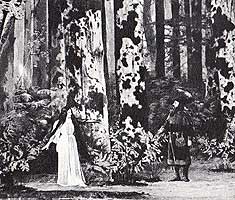
Pelléas exemplified the shared ideals of playwright and composer. Despite its full length, the plot is brief, incidents few, characters simple, setting vague. In keeping with Maeterlinck’s symbolist creed, the whole tale unfolds simply and with inexorable logic. Golaud, a hunter, finds Mélisande in a forest and brings her home, where her attraction to his brother Pelléas ripens as Golaud’s jealousy swells. Golaud slays Pelléas, fatally wounds Mélisande, and is left to ponder the inexplicable meaning of it all, as Mélisande’s newborn takes her place in the cycle of life. The flavor emerges in the very first scene. Golaud wanders in lost while hunting. He spots Mélisande by a stream and asks why she is weeping. She cries out not to touch her and he retreats. In response to his questions, she says only that everyone has hurt her but won’t say how and that she has fled but won’t say from where. Golaud spots a crown lying in the stream but she won’t let him retrieve it. When Golaud boasts that he is the grandson of the old king Arkel, she lets down her guard slightly, marvelling at his beard and stature, and he at her shining eyes, but when he asks her age, she just says she is cold. He convinces her to come home with him, as the night will be cold and dark. As they leave, she asks where he is going and he replies that he doesn’t know, as he too is lost. Clearly, their words mean far more than they merely state. Debussy admired Maeterlinck's approach: “The characters try to express themselves like real people, not in an arbitrary language made up from antiquated tradition.” Thus the language itself is disarmingly direct and plain, with no poetic formatting, rhythm or rhymes, and so basic as to be readily understood with only a few years of high school French. The characters seem immediate, credible and intensely human, rather than aloof or noble. Here, for example, are the lines Golaud sings as he first enters: Je ne pourrai plus sortir de cette forêt. Dieu sait jusqu’ où cette bête m’a mené. Je croyais cependent l’avoir blessée a mort, et voici des traces de sang. Mais maintenant je l’ai perdue de vue. Je crois que je suis perdue moi-même et mes chiens ne me retrouvent plus. Je vais revenir sur mes pas. (I can’t get out of this forest. God knows where that beast led me. I thought I had fatally wounded it, and here are traces of blood. But now I’ve lost sight of it. I think I’m lost and my dogs can’t find me. I’m going to retrace my steps.)With great economy, Maeterlinck paints an efficient portrait of the character who, despite not being named in the title, really is the driving force of the play – he’s earthy, bumbling, intellectually limited, not too articulate, buffeted by fate – and, above all, trapped and lost (and not just literally, of course). The words are functional and prosaic, without any poetic grace, inspiring thoughts or stimulating references. Yet, the expression is quintessentially French, as achieving an adequate translation into English (or any other language) seems impossible. The problem is compounded in the context of a musical setting where scansion must be preserved, often at the expense of the literary flavor. Thus Mélisande's second line, “Ne me touchez pas où je me jette a l'eau” (literally: “Don't touch me or I'll throw myself into the water”) is given in the Schirmer libretto as “No, no touch me not or I shall throw me in,” which, in order to preserve the rhythm, not only sacrifices the grace and ease of the original for a stilted awkwardness but utterly distorts Mélisande's disarmingly naïve and plain-spoken character.
Drawn to the play, Debussy approached Maeterlinck in October 1893 through a mutual friend, Pierre Louÿs. Debussy already had set the climactic love scene, which another friend, Henri de Régnier, extolled to Maeterlinck as “deliciously garlanding the text while scrupulously respecting it.” Admitting that he had no feeling for music, Maeterlinck relied on Louÿs to advise him and granted Debussy use of his play. Rather than create a libretto, Debussy used the play virtually intact. Paul Griffiths points out that this was a revolutionary approach in opera history, although Debussy himself would not follow it – at his death he left fragments of an opera based on Edgar Allen Poe's Fall of the House of Usher, based his own libretto, upon which he had labored for a decade.) Debussy abridged only a few scenes and excised four of Maeterlinck's nineteen. Robert Orledge characterizes the cuts as passages that were purely symbolic (an image of swans fighting dogs) or that over-clarified events or relationships that Debussy left elusive (servants discussing motives for Golaud's slaying of Pelléas).
At first, Maeterlinck was gratified but later turned on Debussy, attacking him with his cane and even threatening a duel over the decision to reject casting his mistress in the lead role. Indeed, a week before the premiere Maeterlinck publicly and suddenly decried alleged “arbitrary and absurd cuts [that] made it incomprehensible” and declared himself “reduced to wishing for its immediate and resounding failure.” He recanted only in 1920, when he first heard the opera and proclaimed himself “a happy man,” adding, rather remarkably: “For the first time I have understood my play.” He later wrote that he was "completely wrong in this matter and that [Debussy] was a thousand times right.” But his remorse was too late to reconcile with the composer, who had died in 1918. Even so, Jacques Bourgeois suggests that Maeterlinck must have felt the need for a musical setting from the outset, as he asked Gabriel Fauré to compose a large score of background music for a London production of the play in 1898, well before Debussy's opera appeared. Debussy completed Pelléas in 1895 but worked on the orchestration for six more years while trying to arrange for a performance. In contrast to the accepted way of stimulating interest in and introducing novel stage works, Debussy refused to allow excerpts to be presented in concert or as an orchestral suite, insisting instead that the opera be given whole or not at all. After many delays, Pelléas finally was produced for the 1902 season of the Opéra-Comique in Paris.
Debussy had wanted rapid changes among the three or four scenes within each act without lowering the curtain, but physical constraints at the cramped theatre led him to compose transitional orchestral interludes several minutes in length for the changes in scenery. Although written in haste and purely as a practical accommodation for the premiere, they now seem an essential part of the conception, seamlessly unifying each act by summarizing in abstract sound the mood of the prior scene and preparing the next one. The dress rehearsal was a near-disaster, as the elite (and hence tradition-bound) invited audience repeatedly burst into derisive laughter. (Mary Garden, cast in the lead role, recalled: “Here was a drama of pure poetry and tragedy and people were giggling and chuckling as if they were at the Folies Bergere.”) While the premiere benefited from a more empathetic and open audience, critics used the opera as a divining rod for their artistic perspectives. Conservatives claimed to be bored or baffled, and often flailed Debussy for having produced a disembodied, meaningless set of effects and for having abandoned the traditional melodic, harmonic and rhythmic bases of music that were deemed necessary to stimulate an emotional response. (Curiously, though, the sets and costumes were quite traditional and invoked the medieval world of the Ring and Parsifal.) One Parisian critic called it, “the decomposition of our art, the emaciation and ruin of our essence,” and another “music without form … deceptive, sickly, almost lifeless.” Even innovators seemed at a loss to fully understand the work or to provide meaningful analyses, yet they sensed and hailed its originality, freshness, refinement and fusion of musical elements, and occasionally foresaw its far-reaching aesthetic implications. Three decades later, Léon Vallas catalogued the enormous outpouring of criticism and summarized the fundamental problem as the sheer novelty and freedom of Debussy's conception, utterly bereft of the familiar anchors and conventions of the opera genre, that: sounded the knell of all former aesthetics. ... Animated by a blind faith in the music of the recent past, they unhesitatingly condemned this new music of the future. ... It would require a vast vocabulary of special words and metaphors, of vague literary equivalents and verbal approximations, to express the deep human significance and the exquisite feeling for nature – those eternal elemental qualities – with which the novel score overflows.
Debussy believed that nothing should impede the progress of the drama and that all musical development not called for by the words would be a mistake His musical contribution to Pelléas goes beyond eschewing the disruption of arias for suitable emotional underlining of the narrative, but rather taking Maeterlinck’s unassuming plot and ambiguous text into a deeper realm. Roger Nichols cites as a telling example the concluding line of the first act, where Pelléas says he might leave and Mélisande asks simply: “Pourquoi partez-vous?” (“Why are you going away?”).
It would be wrong to leave a misimpression that Pelléas wallows for its entire 2½ hour duration in a soft, understated monotone of stares and bland conversation. Far from it! While the mature adults (the doctor, Arkel and Golaud’s mother Geneviève) do restrain their expression, Yniold (Golaud’s young child by his first marriage) chirps perkily, the love scenes between Pelléas and Mélisande soar with unbridled passion and the grim tone of the final act serves as a foil for Golaud’s fitfully violent attempts to assess blame and find meaning in the tragedy he has caused. Indeed, the culmination of the fourth act, as the lovers spot Golaud and know they are doomed, is a musical orgasm, with ecstatic rising vocal phrases, accelerating rhythmic exhortations, a strong lingering embrace, a smoothly flowing orchestral release, and Mélisande gasping for a breath (“Je n'ai pas / de courage”) to blurt her final line as she flees. Nor, for that matter, is Debussy’s writing bereft of melody. Although he deliberately shuns the well-developed, memorable repeated phrases of conventional opera, enticing melodic fragments often flit by. Indeed, Debussy's setting of the text constantly veers between casual conversation and stylized song. In 1909, Debussy wrote that he had striven to remove parasitic elements from his music. Although the score specifies a large complement of instruments, he constantly uses his resources for atmosphere and color, not volume. His sparing orchestration invests each component with heightened significance that transcends the repetition and filler that bloats so many standard operas.
Debussy’s economy should not be mistaken for a dearth of ideas or attention. Richard Langham Smith has provided a fascinating catalog of how a multitude of complex musical elements and devices pervade the work with a subtle subtext of symbolism and commentary that functions largely on a subconscious level. Take, for example, Debussy’s harmonic writing. Beyond the expected use of modality to suggest a timeless, ancient setting, Smith traces a strong correspondence between musical gestures and the sense of the text, as Debussy uses the Lydian mode to suggest aspiration, the Phrygian mode for gloom, whole-note harmony (lacking a tonic anchor or resolution in any particular direction) to imply being lost, harmonic stability to suggest a growing relationship, extended ninth chords for longing and desire, half-diminished chords for sadness and pity, and unresolved or partially-resolved cadences for emotional imbalance. Even the occasional invocation of keys is significant to establish emotional resonance: C major for darkness and F-sharp major (its near opposite in the circle of fifths) for light. Yet, all these effects are subtle, and avoid any suggestion of rigid, predictable or reflexive application. In his treatise on The History of Orchestration, Adam Carse neatly summed up the magic of Debussy’s instrumental writing: In Debussy’s hands the orchestra became a super-sensitive instrument. In Pelléas and Mélisande, it murmurs dreamily to itself, speaks or suggests in veiled tones, swells up for a moment and again subsides or dwindles down almost to disappearance. [This] delicacy and tentative experiments in impressionistic tone-painting … created his own manner of orchestral speech. Debussy’s vocal writing is equally striking. In 1909 he wrote somewhat defensively that he had “tried to prove that when people sing they can remain natural and human without having to look like idiots or conundrums.” (His direct reference was to the emerging trend of verismo, an overtly emotive style of high-power expression that he called “vulgar and imbecilic” but which, to be fair, does stem from the considerably wider emotional range of Italian parlance.)
The structure of Pelléas is remarkable as well. Throughout nearly its entire prior 300-year history, opera had been organized as alternating between passages of spoken or barely sung recitative that advanced the story and arias in which the narrative paused to enable the characters to elaborate their feelings (and display their vocal technique, of course). Pelléas, though, has no arias at all, instead presenting each scene as a continuous flow that makes no distinction between the functions of story and personality. Even so, Orledge notes that while there are no self-contained arias, all the main characters have set pieces in which they become the focus. And as if to tease us, Debussy inserts a sole snatch of true song at the opening of act III as Mélisande combs her long hair – one brief, largely unaccompanied verse and chorus of an ancient ballad – thus not only defining Melisande’s ageless purity but also serving as a reminder of the striking distance of the remainder of the opera from conventional writing. (Notably, Verdi ended his final opera, Falstaff, with a related gesture, by which he emphasized his own innovative avoidance of traditional arias by concluding with a formal fugue, perhaps the least likely component of any opera.) Debussy's only other concessions to traditional opera are so rare as to attract immediate attention. Thus, the only choral passage presents distant sailors lost at sea (thus symbolically encapsulating the overall theme), the only sustained notes highlight moments of extreme emotion (both of love and anger), and the only overlap of voices heightens the lovers’ panicked fear of discovery by the menacing Golaud. Beyond its intrinsic fascination,
Yet, Pelléas is full of motifs, including one for each of the three principal characters.
While theorists can speculate as to the two composers’ similar use of motifs, the differences between their overall aesthetics are readily heard. Wagner is more overtly theatrical, with his singers often straining at the top of their registers to deliver stentorian declamation at a sustained fever pitch,
Above all else, Wagner’s motifs seem more emblematic and his music more prescriptive in guiding listeners to a single intended meaning and urging them to become swept away in a tide of heightened sensation, whereas Debussy’s are far more evocative and suggestive, appealing to those who seek an individualized interior reality.
Debussy himself spoke little of his aesthetic intentions, and then only in epigrams. Perhaps the closest he came to a self-analysis was in a letter he wrote to the Opéra-Comique for a revival of Pelléas. He stated that he hated classical development, whose beauty was merely technical, but desired music of freedom, not confined to reproducing nature, but devoted to the mysterious affinity between nature and the imagination.
Ernest Ansermet, the great Swiss conductor and exponent of French music, whose perception was abetted by his mathematical background, expanded Debussy’s analysis of his operatic style in album notes to his superb 1964 recording: Debussy’s essential characteristic [was] his unfailing ability to express a musical idea in the freshest and most direct terms, without bothering to develop it thematically as the classics did, and without letting it run away with him as the romantics delighted in doing. This need of direct expression which is constantly in a state of conception implies a constant fund of sensibility which is seen in a maximum of liberty in melodic behavior and harmonic formation[, …] thus producing a dialectic which … never becomes a rhetoric.In a mixture of modesty and pride, Debussy had written: “I do not pretend to have discovered everything in Pelléas; but I have tried to trace a path that others may follow, broadening it with individual discoveries which will, perhaps, free dramatic music from the heavy yoke under with it has existed for so long.” Yet, having forged a radical new course in Pelléas that seemed to burst with further possibilities to liberate the genre from the formal structures and conventions of the prior three centuries, Debussy never pursued it himself in another opera. That would be left to others. Yet the influence of Pelléas far outshone its limited early success, as it clearly paved the way to the spare instrumentation and sprechstimme of the new Viennese school. André Messager, the conductor of the premiere, said: “When Melisande asks for the window to be opened in the last scene, she let in not only the sunset but all modern music.”
The history of Pelléas recordings began a mere two years after the premiere when Debussy himself accompanied Mary Garden, who created the role of Mélisande, in a two-minute excerpt from the opera (and three unrelated songs). Before beginning rehearsals, Debussy played through the entire score on a piano, singing all the parts himself, and cautioned the cast, "Everyone must forget that he is a singer before he can sing my music." Indeed, a tiny (five-foot, hundred-pound) Scottish singer trained in France, Garden was known more as an expressive vocal actress than as a pure singer. Debussy had praised her art, recalling that he had watched in awe during rehearsals as “little by little the character of Mélisande took shape in her.
Garden’s successor as Mélisande, Maggie Teyte, assumed the role in 1908. She later recalled that she had studied the part with Debussy every day for nearly half a year, and that he was an exacting and often temperamental teacher. Although Teyte never recorded the role, nearly four decades later she cut two curious excerpts with piano accompaniment by Gerald Moore – Geneviève’s Act I, Scene 2 recitative (“Voici ce qu’il écrit à son frère Pelléas”) and both parts of a dialog dominated by Pelléas in Act IV, Scene 4 (“Tu ne sais pas pourquoi il faut que je m’éloigne?”) While not necessarily portraying the earmark of her youth, those, along with 14 Debussy songs in 1936 with Alfred Cortot (and several others in the 1940s with Moore), still reveal a confident, beautifully balanced voice poised between pure tone and tasteful expression that must have immeasurably enlivened her interpretation. The most historically important Pelléas recording came in 1928 when Hector Dufranne, who created the role of Golaud, revived his part for a French Columbia set of excerpts conducted by Georges Truc.
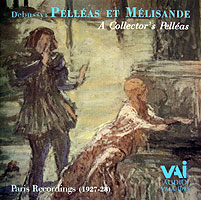 Rather than attempt to abridge the entire opera, the 41-minute set presented five scenes intact, including one especially bold and surprising choice – the lengthy and rather dry narrative of Act I, Scene 2, in which Geneviève and Arkel read and comment on a letter Pelléas has received from Golaud describing his meeting and marriage with Mélisande (the same scene that Garden excerpted). While shorn of most of its orchestral prelude, the opening scene is a revelation, as Dufranne and Marthe Nespoulos deliver their lines conversationally, with precise rhythm, diction and enunciation, finely graded dynamics and an attenuated yet affecting emotional range – even when Golaud boasts of his ancestry or when Mélisande threatens to throw herself into the stream. While this approach may sound incurably bland by accustomed operatic standards, apparently it is how Debussy envisioned his work, and indeed it exemplifies his professed aesthetic outlook, as well as the fatalism of the symbolist movement from which the play emerged (together with the pallid, frail and pervasive sadness of the pre-Raphaëlite movement that preceded it). The other cast members (Alfred Maguenat as Pelléas, Claire Croiza as Geneviève and Armond Narçon as Arkel), while not directly associated with the composer, were key early interpreters of their roles and, as Allan Altman notes, were all Parisian singers, and thus firmly ensconced in the diffident style Debussy had in mind when he wrote all his vocal work, including Pelléas. Rather than attempt to abridge the entire opera, the 41-minute set presented five scenes intact, including one especially bold and surprising choice – the lengthy and rather dry narrative of Act I, Scene 2, in which Geneviève and Arkel read and comment on a letter Pelléas has received from Golaud describing his meeting and marriage with Mélisande (the same scene that Garden excerpted). While shorn of most of its orchestral prelude, the opening scene is a revelation, as Dufranne and Marthe Nespoulos deliver their lines conversationally, with precise rhythm, diction and enunciation, finely graded dynamics and an attenuated yet affecting emotional range – even when Golaud boasts of his ancestry or when Mélisande threatens to throw herself into the stream. While this approach may sound incurably bland by accustomed operatic standards, apparently it is how Debussy envisioned his work, and indeed it exemplifies his professed aesthetic outlook, as well as the fatalism of the symbolist movement from which the play emerged (together with the pallid, frail and pervasive sadness of the pre-Raphaëlite movement that preceded it). The other cast members (Alfred Maguenat as Pelléas, Claire Croiza as Geneviève and Armond Narçon as Arkel), while not directly associated with the composer, were key early interpreters of their roles and, as Allan Altman notes, were all Parisian singers, and thus firmly ensconced in the diffident style Debussy had in mind when he wrote all his vocal work, including Pelléas.
A rival set of 14 sides conducted by Pierro Coppola had been issued in 1927 by French HMV. Fortunately, only a few of the scenes overlap with the Columbia album and five of the interludes are included, so between the two sets we have nearly half of the opera. All three HMV leads (Charles Panzera as Pelléas, Yvonne Brothier as Mélisande and Vanni-Marcoux as Golaud) were well-known stars and present more forward and outwardly expressive characterizations, while Coppola leads with greater rhythmic and dynamic variety and emphasis, thus providing a nice stylistic complement to the Columbia set. Both are on Pearl CDs or combined on a VAI CD.
The first recording of the full opera was made in April and May 1941 in Paris, Whether a tribute to the lasting qualities of the 1941 venture, Among recordings of the full opera, one bears a special historical pedigree. Of all the conductors of Pelleas on record, the composer’s closest bond was with Desiré-Émile Inghelbrecht, whom he considered a gifted interpreter and whom he entrusted with the choir for the 1911 premiere of his Le martyre de saint Sébastien. Although Inghelbrecht never recorded Pelléas in the studio, he led annual performances and left us two magnificent broadcasts, with the Philharmonia (and Suzanne Danco as Mélisande, Camille Mauranne as Pelléas and Henri Etcheverry as Golaud) on the BBC on June 1, 1951 (Testament CD) and – in his 83rd year! – with the ORTF (and Micheline Grancher, Mauranne and Jacques Mars) at the Theatre des Champs Elysees on March 12, 1963 (RTF Inedits LP). One more monaural set boasts special appeal – Among many stereo recordings, two exemplify for me the poles of inspired interpretive approaches to this unique work. Often cited
The other interpretive extreme comes from a rather unlikely source. A middle ground is tilled by the critically-praised 1992 set led by Claudio Abbado on DG. The cast (Maria Ewing as Mélisande, François Le Roux as Pelléas, José van Dam as Golaud, Christa Ludwig as Geneviève and Jean-Philippe Courtis as Arkel) is credible and the Vienna Philharmonic plays with its accustomed rich sheen. For me, the recording of Pelléas that comes closest to realizing Debussy’s ideal came from Ernest Ansermet and his Orchestre de la Suisse Romande in their 1964 remake with Erna Spoorenberg (Mélisande), Camille Maurane (Pelléas), George London (Golaud), Guus Hoekman (Arkel) and Josephine Veasey (Geneviève) (Decca). Like Debussy, Ansermet strove in all his work for clarity, efficiency, precision and proportion, and never more so than here. In his notes to this set he cited as his challenge “bringing out the continuity of the melos, scattered between the instruments and the voices, and giving the vocal line its true value without preventing it from being bathed in the orchestral harmony that clarifies its meaning.” Like the pioneering 1941 venture a generation before, Ansermet’s forces live and breathe the score, but with a difference – the recording is so detailed as to add a further layer of meaning to enhance Debussy’s art. Ansermet’s recording is a remarkable achievement. Perhaps, then, he should have the last word: “[Pelléas] realizes at once that miracle which the musical theatre has always tried to produce as the highest ideal: the perfect identification of a musical essence with its poetic substance.” In addition to my own heart and ears, I am indebted for this piece primarily to a number of insightful sources:
Copyright 2014 by Peter Gutmann | |||||||||||||||||
     For a note about the illustrations, please click here.
  | ||||||||||||||||||
copyright © 1998-2014 by Peter Gutmann. All rights reserved. |

 Rather, he insisted that while the text was to be clear and strong, the music was not to be dormant but was meant for the inexpressible where speech leaves off, emerging and returning discretely from shadows. Yet the musical development would be motivated by the words and could not impede their dramatic action.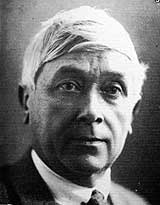

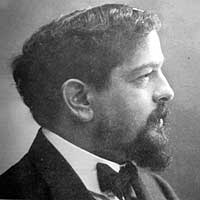
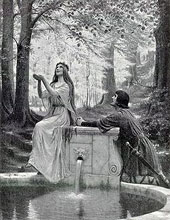

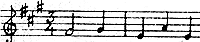
 Consider this line of Mélisande in the first scene when Golaud notices her discarded crown. The first bar follows the natural inflection of declaratory speech, rising at the end of a question (“Où donc? [Where then?]”) and soaring yet higher for an excited exclamation (“Ah!”). The next two bars (“Ce'st la couronne qu'il m'a donnée. [That's the crown he gave me.]”) combine the natural rhythm of the spoken words with the falling tones of wistful regret. (Yet, consistent with operatic convention, note that the normally silent final vowels of "couronne" and "donnée" are sung as separate syllables.) The last two bars (“Elle est tombée en pleurant. [It fell in while I was crying.]”) suggest a shred of lovely melody which, typically, is never repeated, developed or picked up by the orchestra as it would be in a traditional opera, but rather merely hints at a budding romantic attraction between the gruff hunter and the enigmatic victim and then evaporates.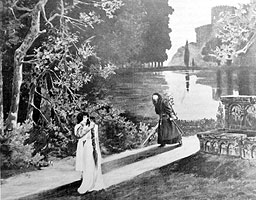



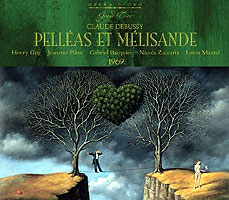

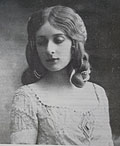

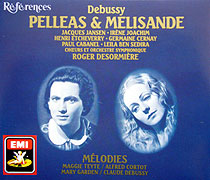 where the Occupation perhaps stimulated the artists to preserve and disseminate this cherished object of their national culture. The result is a fine realization, a team effort that respects the score while presenting the interrelationships among living characters with both care and empathy, warm yet fully accurate. The pedigree was clear – not only were the singers current stars of the Opéra-Comique, but both Jacques Jansen (Pelléas) and Irène Joachim (Mélisande) trained under Georges Viseur, who had served as vocal coach for the premiere, and Joachim was further guided by studying her role with Mary Garden. From the very outset, the sheer humanity of the conception is unmistakable – in the introduction conductor Roger Desormière leans into the music, gently coaxing the Golaud and Mélisande themes out of the earthy continuity of the orchestral fabric amid freely applied organic swells of tempo and dynamics. The characters, too, are deeply felt without exaggeration – Joachim alters the quality of her voice when appropriate to paint a portrait of reticence and privacy, Germain Cernay (Geneviève) reads each phrase of Golaud’s letter with motherly warmth, and when Henri Etcheverry (Golaud) discovers that Mélisande’s ring is missing he doesn’t suddenly explode in anger, as in nearly all other interpretations, but rather darkens with concern and thereby immeasurably deepens his character beyond the dumb brute who is often routinely portrayed. Even Leila ben Sedira transforms the rather thankless role of Yniold, Golaud’s prepubescent son by a former marriage, from screechy annoyance to poignancy. The overall impact is to urge us to become active participants in the creative process by providing the feelings at which the singers only hint and thus to reconstitute much of the effect of the composer’s conception. As Jansen recalled in 1984: “I confess that I don’t listen to this recording any more. I carry it with me now, it is part of me, it dwells in me … to go with me on that long voyage to the fountain-head of Debussy.” Even apart from its undeniable historical status, this remains an altogether extraordinary and deeply involving experience that fully communicates the essence of the work and served as a model for all that would follow.
 or fear of the burden of issuing a work of more curiosity value than popularity that would have required 40 12-inch 78 sides, no further complete versions appear to have been made until the LP era. A 1951 set by Ansermet and his Suisse Romande Orchestra boasted a fine cast (Pierre Mollet as Pelléas, Suzanne Danco as Mélisande, Henri Rehfuss as Golaud, André Versiere as Arkel and Hélène Bouvier as Geneviève), dynamic subtlety and a vividly detailed recording, but was superceded by the greater atmosphere of their stereo remake, noted below. For a 1957 mono EMI set by André Cluytens and the Orchestre National de la Radiodiffusion Française, Jansen reprised his role as Pelléas, joined by Victoria de los Angeles as Mélisande, Gérard Souzay as Golaud and Pierre Froumenty as Arkel, but the result seems more flat and perfunctory than open-ended and neutral
 and never evolves from primordial forest and tentative introductions to the heady freedom of Pelléas and festering jealousy of Golaud, but remains mired in a deliberate and even plodding homogeny. Both the playing and singing throughout is sweet and beautiful, but too much so – the excessive pervasive warmth is fine for the love scenes but ruins the balance of stylized myth and natural realism by unduly attenuating the climaxes, blunting the impact of the more dramatic episodes, and suppressing the grace and clarity of Debussy’s concept, as well as the other-worldly mystery with which the entire work is suffused. The LP edition was further compromised by poorly-planned side breaks that fragmented all but the final act.
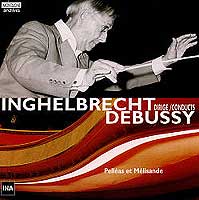 Inghelbrecht declared that he was perpetuating the approach of André Messager, who had prepared and led the premiere under Debussy’s guidance and thus presented the composer’s intentions, and whom Inghelbrecht recalled as having cast a spell of musical impressionism featuring fluidity of tempo and a subtle shifting of texture, leaving Inghelbrecht unable to discern the ingredients. (In his rich description, the instruments didn’t enter but rather insinuated themselves.) Under Inghelbrecht’s baton, all flows with exceptional smoothness among the score’s tempo indications of “animé,” “réténu,” “moderé” and the like, yet with due regard for the drama, an approach that is especially effective to enliven the driest scenes, notably the one in which Golaud’s son Yniold tries in vain to free his ball from under a heavy rock and then ponders a herd of sheep passing in the far distance (all symbolic, of course). Of further unusual interest is the vibrato-laden singing, which, as Jacques Bourgeois points out, serves to recall that Paris was the center of the bel canto style and thus forms a fascinating link to the prevailing French vocal tradition of the era – and, at the same time, serves as a stylistic bond to the more ardent passages in which Debussy’s vocal writing tends to become slightly more conventional (although never lapsing into Wagnerian/verismo surfeit or the repetition of text on which arias are based).
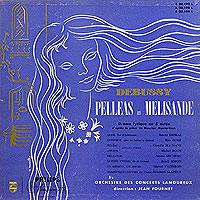 a 1952 recording with Camille Maurane (Pelléas), Janine Micheau (Mélisande), Michel Roux (Golaud), Rita Gorr (Geneviève), Xavier Depraz (Arkel) and the Orchestre des Concerts Lamoureux led by Jean Fournet (Philips LP and CD). The forces are predominantly French and the overall impression idiomatic, yet it tends to be the most outwardly bold and assertive of all the recordings I’ve heard and for that reason alone might serve as the best entrée to this work, especially for those used to conventional opera who have difficulty grasping the essence of Debussy’s vastly divergent approach. Much of this arises in the orchestral portion, in which phrases are shaped with great attention to their dramatic significance, although not necessarily in the most obvious passages most prone to emotional underlining; indeed, some of the overtly climactic summits seem deliberately attenuated while the painfully protracted scene in which Golaud prods Yniold to spy on Pelléas and Mélisande surges with perverse excitement. The voices are suitably expressive but mostly tend to overwhelm the accompaniment – even the supposedly distant sailors and shepherd are way too pronounced to suggest an atmosphere of cosmic mystery. Even so, the vocal dynamics can be revealing – in the opening scene Mélisande’s hushed lines are literally dominated by the sheer heft of the booming Golaud, while in her later passages with Pelléas the volume is
far more finely balanced, thus neatly conveying the character of her two relationships – a creative use of the aural recording medium that compensates for the absence of all the other theatrical elements.
a 1952 recording with Camille Maurane (Pelléas), Janine Micheau (Mélisande), Michel Roux (Golaud), Rita Gorr (Geneviève), Xavier Depraz (Arkel) and the Orchestre des Concerts Lamoureux led by Jean Fournet (Philips LP and CD). The forces are predominantly French and the overall impression idiomatic, yet it tends to be the most outwardly bold and assertive of all the recordings I’ve heard and for that reason alone might serve as the best entrée to this work, especially for those used to conventional opera who have difficulty grasping the essence of Debussy’s vastly divergent approach. Much of this arises in the orchestral portion, in which phrases are shaped with great attention to their dramatic significance, although not necessarily in the most obvious passages most prone to emotional underlining; indeed, some of the overtly climactic summits seem deliberately attenuated while the painfully protracted scene in which Golaud prods Yniold to spy on Pelléas and Mélisande surges with perverse excitement. The voices are suitably expressive but mostly tend to overwhelm the accompaniment – even the supposedly distant sailors and shepherd are way too pronounced to suggest an atmosphere of cosmic mystery. Even so, the vocal dynamics can be revealing – in the opening scene Mélisande’s hushed lines are literally dominated by the sheer heft of the booming Golaud, while in her later passages with Pelléas the volume is
far more finely balanced, thus neatly conveying the character of her two relationships – a creative use of the aural recording medium that compensates for the absence of all the other theatrical elements.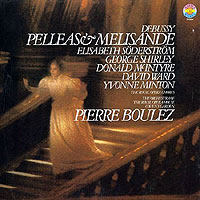 – both for better and for worse – as the most objective recording is the 1971 Covent Garden set led by Pierre Boulez with George Shirley (Pelléas), Elisabeth Söderström (Mélisande), Donald McIntyre (Golaud), Yvonne Minton (Geneviève) and David Ward (Arkel) (Columbia LP; Sony CD). Bourgeois, for one, slams it for sacrificing impressionist suppleness for cold analysis. (To briefly digress – I have to wonder if prejudice against Boulez’s approach as a conductor is colored by distaste for his thorny compositions, although that never kept Arthur Schnabel, who also wrote in an unpopular modern style, from being lauded as a supreme interpreter of the romantic repertoire. And in any event, such “literal” conductors as Toscanini and Reiner were universally praised for their Debussy recordings.) Yet, while Boulez does adhere closely to the score he’s far from rigid, and when he does cut loose he adds considerable force to the climax of Act IV, which startles as the voices, which have been dominant throughout, become drowned out by an instrumental tsunami.
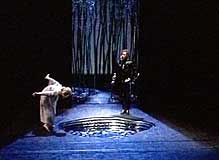
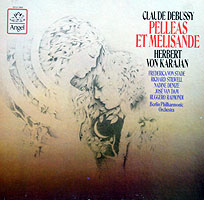 Herbert von Karajan was hardly known for the warmth and humanity of his interpretations. On the contrary, many came to regard him as at best objective and at worst mechanical and superficial. Yet, his 1978 EMI Pelléas with Frederica von Stade (Mélisande), Richard Stillwell (Pelléas), José van Dam (Golaud), Ruggerio Raimondi (Arkel), Nadine Denise (Geneviève) and the Berlin Philharmonic (hardly a French artist in the group) emerges as unabashedly romantic. The orchestral part is bathed in a luminous aura and the vocalists, while generally adhering to the indicated rhythms, constantly extend final notes to which Debussy assigns the same short values as their predecessors. Somewhat slow (162 minutes, compared to others' 148 [1951 Ansermet], 151 [Desormiere], 153 [1964 Ansermet] and 154 [Boulez]), it never flags but rather presents us with a deeply empathetic fatalistic tragedy that I find wholly engrossing. To complete the irony here, many have cited this set as Wagnerian – I can only wonder what Debussy, the self-proclaimed musicien français, would have said about that!
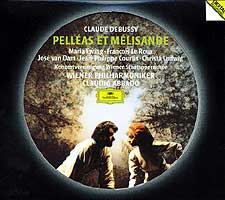 A tribute to the ability of international artists to adapt to the demands of national schools, the result is lushly romantic – oils more than watercolors. Reminiscent of Fournet's approach, it even evokes late 19th-century tradition, adding emotional underlining without violating the idiomatic essence of the score, and can serve as a safe introduction, although without the individuality of the versions already noted. Speaking of introductions, a word of warning – in 2003 Abbado and the Berlin Philharmonic recorded for DG a half-hour instrumental suite. Arranged by Erich Leinsdorf, who had cut an abbreviated version for Columbia with the Cleveland Orchestra in 1946, it consists mainly of the orchestral interludes. Evocative but utterly pointless – somewhat akin to taking a cruise from one fabulous port of call to another but never alighting from the ship – it leaves a monotonous misimpression of arbitrary meandering and certainly does not provide a valid initiation to the soul of the work. Rather, it unwittingly proves the extent to which the text and its presentation are an integral and essential part of this opera, which simply cannot exist in their absence (as well as Debussy's wisdom in refusing to sanction such butchery).
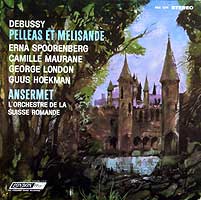 The soundstage is thoroughly convincing, with voices slightly moving and receding with the action, and atmospheric resonance reflecting the settings and moods – the reverberant sound of the grotto where Golaud threatens Pelléas is truly terrifying without being overdone. Not only are the instrumental textures and their interplay fully displayed, but the timbres of the voices add complexity to the characters, tracing Mélisande’s transformation from scared waif to viable lover and then reverting to a wimpering cipher on her deathbed. While clearly respecting the French theatrical tradition of diffident lyrical expression, the vocal acting runs the gamut from the wrenching poignancy of Mélisande quietly sobbing “Je ne suis pas heureuse” (“I am not happy”) and piteously dissembling as she tries to explain the loss of her heirloom ring, to Golaud’s frighteningly intense demented tirade (abetted by snarling brass) and Pelleas's ardent profession of love. (The only weak link in the cast is an infantile-sounding Yniold, admittedly a difficult and unrewarding role.) The orchestral playing is superb, beautiful without lapsing into affectation, and Ansermet leads it all with sustained focus on presenting the external content while enabling us to explore its implications, keeping a firm grip on the emotional vicissitudes, ideally balancing stylized artistry and underlying emotion, and selecting tempos so “right” that the whole thing seems to transcend time and place to dwell in a universe that is remote yet infused with our most basic human feelings.